
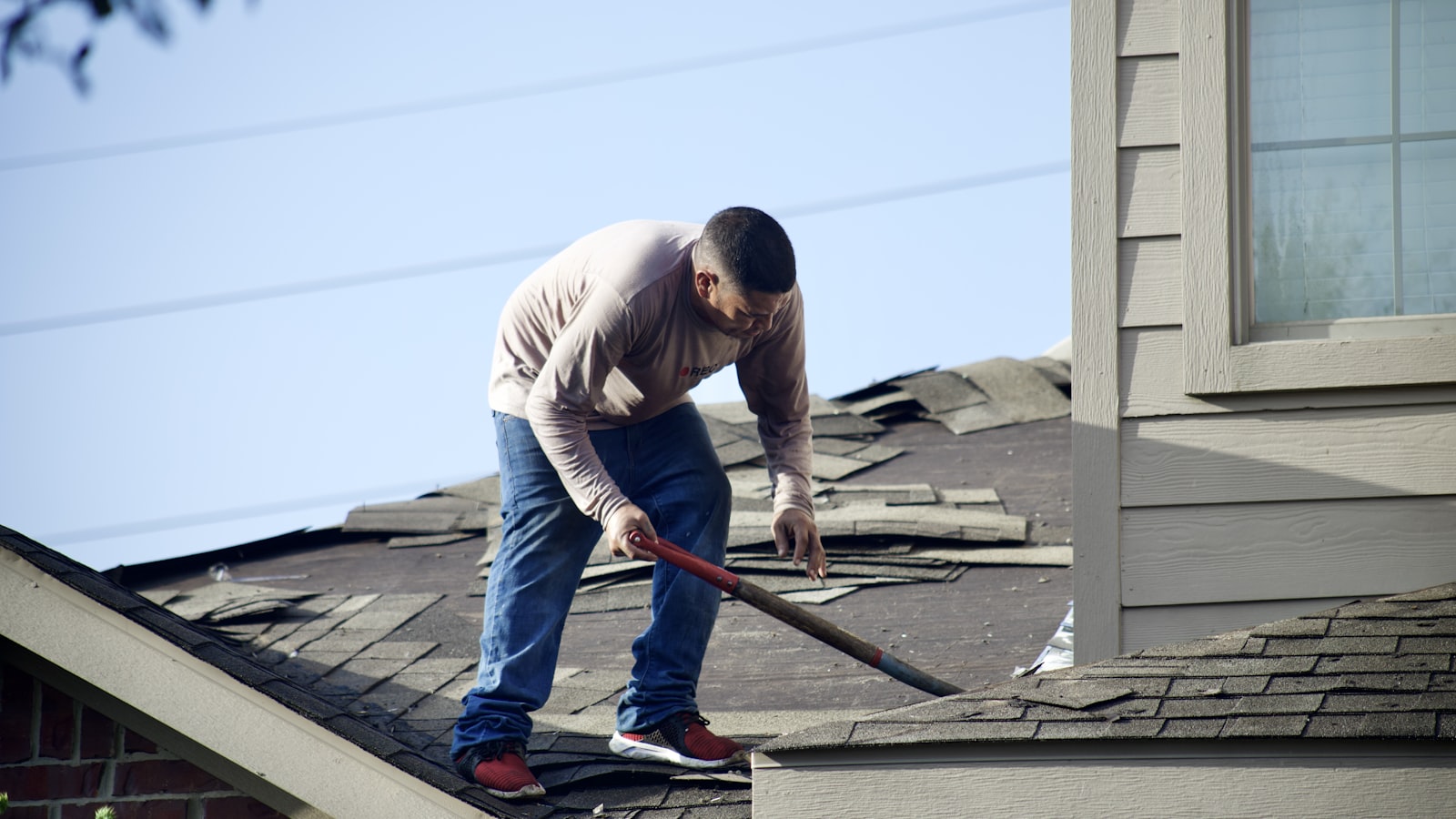
There are three bundles of shingles in a square for standard architectural shingles, so one bundle covers about 33.3 square feet. Heavier products run four or five bundles to the square, and that difference changes a roof order by a third or more, so the wrapper matters more than the rule of thumb.
What a square actually is
A square is 100 square feet of finished roof. It is the unit the entire trade quotes in, which is why a roofer talks about a twenty square roof rather than a two thousand square foot one. The ARMA residential asphalt roofing manual (PDF) puts it in one line: every 100 square feet is called a square for ordering purposes.
Bundles are the packaging. A bundle is what one person can reasonably carry up a ladder, roughly 50 to 80 pounds, and how many of them make a square depends entirely on how heavy the shingle is.
Those two facts are the whole reason the question exists. The square is a fixed measure of area and never changes. The bundle is a fixed measure of weight and changes coverage constantly. Every estimate has to travel from one to the other, and the number of bundles of shingles in a square is the exchange rate.
Coverage per bundle
sq ft per bundle = 100 ÷ bundles per square
3 bundles a square = 33.3 sq ft · 4 = 25 sq ft · 5 = 20 sq ft
What the bundle count does to a real order
Take a 50 by 30 foot building with a 6/12 roof, which works out at 1,845 square feet of roof once a 10% allowance is added:
- 3 bundles a square, standard architectural: 56 bundles.
- 4 a square, heavier laminated: 74 bundles.
- 5 a square, premium and designer profiles: 93 bundles.
That is a spread of 37 bundles on the same roof, decided by the product rather than the building. If your supplier quotes by the square instead, the same roof is about 19 squares.
Check the wrapper, not the internet. Three to the square is the most common arrangement and it is the wrong assumption often enough to matter. The coverage is printed on every bundle, and on a roof this size assuming three when it is four leaves you eighteen bundles short on the last day.
Bundles per square by shingle type
The pattern is consistent even though the exact count is not. Heavier shingle, fewer in a bundle, more bundles in a square.
Three-tab: three bundles
The flat single-layer shingle, and the lightest common product. Three to the square is close to universal here, at 33.3 square feet a bundle.
Architectural: usually three, sometimes four
Laminated shingles have two layers bonded together, so they weigh appreciably more than three-tab. Most standard lines still fit three to the square, but the heavier laminates in the same family cross into four, and they sit on the same shelf under a similar-looking wrapper. This is where the assumption fails most often.
Designer and premium: four or five
Thick multi-layer profiles that imitate slate or shake are heavy enough that a bundle covers only 25 or even 20 square feet. On a large roof this is the difference between one delivery and two, and between a job you can carry up in a day and one you cannot.
Starter and ridge are counted differently
Neither is sold by the square, because neither covers area. Starter strip and ridge cap bundles are labeled in linear feet of coverage, so they are counted against your eave, rake, ridge and hip measurements rather than against your roof area. Adding them to a bundle count is a common way to end up with the wrong number in both directions.
The pitch decides how much roof there is
Before the bundle count means anything, you need the roof area, and that is not the footprint. A roof is measured from the ground as a footprint and covered on the slope, and the slope is always larger.
- 4/12 pitch: multiply the footprint by 1.054. A 1,500 sq ft footprint becomes 1,581 sq ft, needing 53 bundles.
- 6/12 pitch: multiply by 1.118, giving 1,677 sq ft and 56 bundles.
- 12/12 pitch: multiply by 1.414, giving 2,121 sq ft and 71 bundles.
Between a shallow roof and a steep one on the same footprint, that is eighteen bundles of difference. Ordering off the footprint on a steep roof is the most common way a job runs short.
Finding your pitch without getting on the roof
From inside the attic, hold a level against the underside of a rafter, mark 12 inches along it, and measure straight down from that mark to the rafter. The number of inches you measure is the rise, so a drop of 6 inches over 12 is a 6/12 pitch. Every multiplier above comes from the same right triangle.
Slope multiplier from pitch
multiplier = √ ( rise² + 12² ) ÷ 12
6/12 gives 1.118 · a 1,500 sq ft footprint becomes 1,677 sq ft of roof
Turning a quote in squares back into bundles
Suppliers move between the two units freely and will often quote a roof one way and price the delivery the other. The conversion runs both directions off a single number.
- Squares to bundles: multiply the squares by the bundles per square. 20 squares of a three-bundle product is 60 bundles.
- Bundles to squares: divide. 74 bundles of a four-bundle product is 18.5 squares, not 24.7.
- Sanity check: the square count for a given roof never changes. If two quotes disagree on squares, they disagree about the roof. If they agree on squares but not bundles, they are quoting different products.
That last check is worth running on any two bids that come in far apart. A bid that looks a third cheaper is sometimes a lighter shingle rather than a better price, and the bundle count is where it shows.
What the bundle count leaves out
Shingles are one line on the order. These are separate, and several are sold by the linear foot rather than the square.
- Starter strip along every eave and rake, and ridge cap along every ridge and hip, both by the linear foot.
- Underlayment, plus ice and water shield where code requires it at eaves and valleys.
- Drip edge, valley flashing, step flashing and pipe boots, all counted individually.
- Nails, and on a re-roof, disposal of everything coming off.
Waste is the other line. Ten percent suits a simple gable where the offcuts are mostly starter and ridge; a cut-up roof with hips, valleys and dormers wants fifteen, because every valley is a diagonal cut down both sides and those offcuts are unusable.
The roofing calculator takes the footprint and the pitch and returns the bundle count, and you can enter 100 as the coverage to get the answer in squares instead.
Work out your own roof
Frequently asked
Three for standard architectural shingles, so each bundle covers about 33.3 square feet. Heavier laminated products run four to the square at 25 square feet, and premium profiles five at 20 square feet.
About 33.3 square feet at three bundles per 100 square foot square. Always check the wrapper, since a four-bundle product covers 25 square feet and assuming three would leave you well short.
That depends on the pitch, because 1,500 is usually the footprint rather than the roof. At 6/12 the roof is 1,677 square feet and needs about 56 bundles with a 10% allowance; at 12/12 it is 2,121 square feet and 71 bundles.
One hundred square feet of finished roof. It is the unit the trade quotes and orders in, so a 2,000 square foot roof is described as a twenty square roof.
Ten percent for a simple gable roof, where waste is mostly starter course and ridge caps. Fifteen for a cut-up roof with hips, valleys and dormers, since every valley produces diagonal cuts that cannot be reused.