
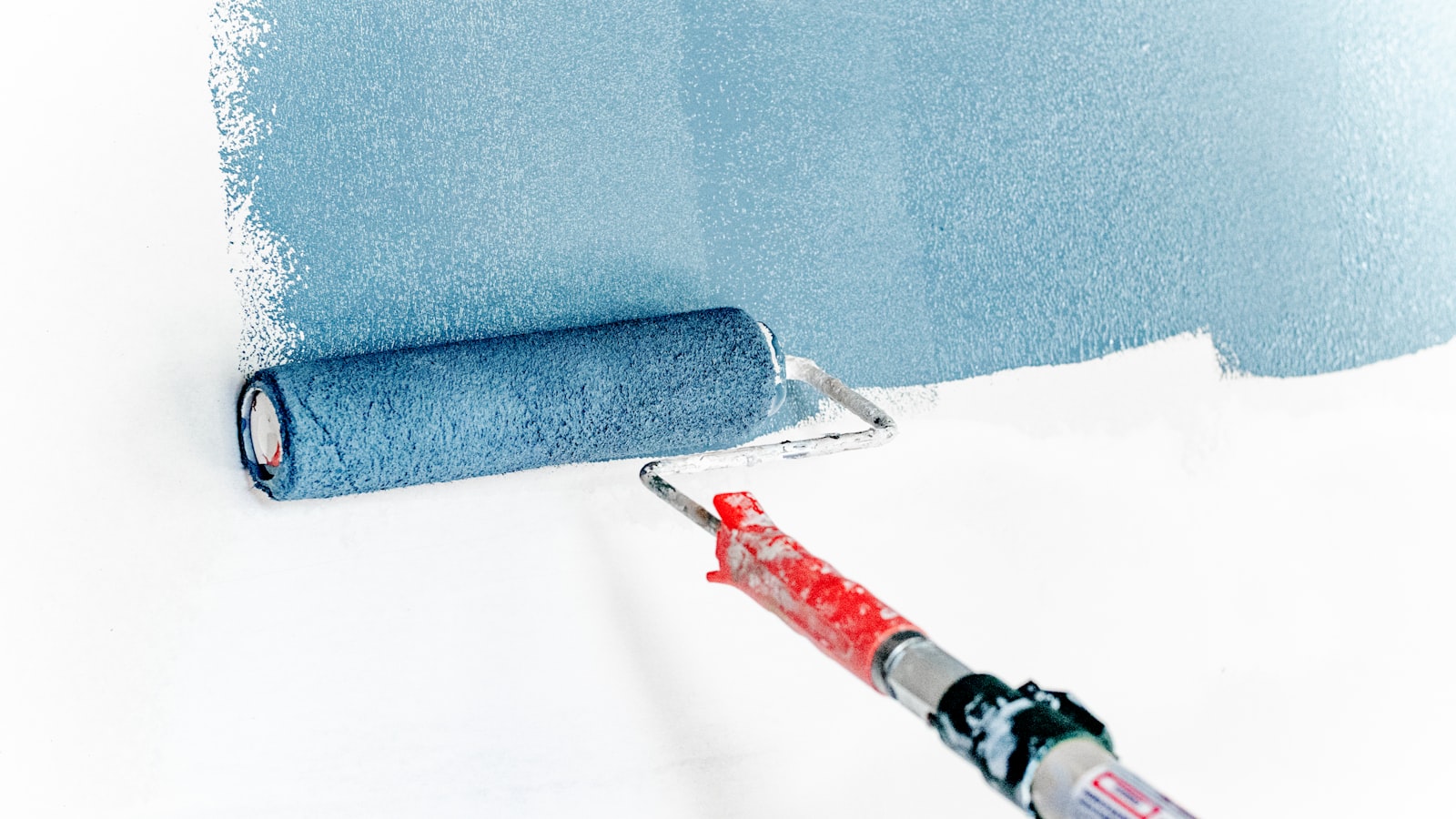
A gallon of paint covers about 350 square feet in one coat on smooth, primed drywall. That is the planning number. The honest range, taken from the people who make the paint, is 250 to 450 square feet: Sherwin-Williams publishes 350 to 400, Behr publishes 250 to 400 for one coat, and the data sheet for Benjamin Moore Regal Select gives 400 to 450 at the recommended film thickness.
That spread is not the brands hedging. It is one gallon spread at different thicknesses, and on a single ordinary room it is the difference between buying two gallons and buying four.
How many square feet a gallon of paint covers is set by thickness
A US gallon is 231 cubic inches. Spread over a wall, the area it reaches is fixed by how thick the film is, because area is volume divided by thickness. Paint film is measured in mils, and a mil is one thousandth of an inch. The whole published range falls out of that one division.
Coverage from thickness
square feet per gallon = 1,604 ÷ wet film thickness in mils
231 cubic inches, divided by a thickness, converted to square feet
- 3.5 mils wet gives 458 square feet
- 3.8 mils wet gives 422 square feet
- 4 mils wet gives 401 square feet
- 5 mils wet gives 321 square feet
- 6 mils wet gives 267 square feet
The Benjamin Moore sheet asks for 3.8 mils wet and states 400 to 450 square feet, which is the same answer this arithmetic gives. What the printed figures add is the loss the arithmetic leaves out: paint left in the tray, on the roller and in the can, and paint that soaks into the surface instead of sitting on it.
What pushes a wall to the low end
- Texture. Orange peel and knockdown add real surface area to the same nominal square footage, so the wall is bigger than the tape measure says.
- Porosity. New drywall, bare wood and masonry drink the first coat. That is what primer is for, and it is why the first coat over fresh board covers less than the second.
- Method. A sprayer lays an even film and loses some to the air. A roller puts more of the tray on the wall but lays it less evenly, which is where the thick patches come from.
- Color change. Covering a saturated color is a coats problem rather than a coverage problem, but it lands on the same shopping list.
The second coat goes further than the first
The first coat fills and seals. The second lands on a surface that is already sealed, so less of it disappears into the wall. Budgeting both coats at the same coverage figure, which is what a calculator does, is the conservative choice and usually leaves part of a gallon spare.
What it does to a real room
A 12 by 14 room with 8 foot ceilings has 416 square feet of wall: a perimeter of 52 feet times 8 feet of height. Two coats means 832 square feet of paint to buy. Where the coverage figure lands decides what you carry to the till:
- At 250 square feet per gallon: 4 gallons
- At 300: 3 gallons
- At 350: 3 gallons
- At 400: 3 gallons
- At 450 square feet per gallon: 2 gallons
Same room, same two coats, and the order moves between two and four gallons on the coverage number alone. No other input on the page has that much leverage, which is why the calculator asks for coverage rather than burying 350 in the math. The number you want is printed on the can you are about to buy.
Work out your own room
A 5 gallon bucket covers about 1,750 square feet
Five times the gallon figure: about 1,750 square feet in one coat at 350, and 1,250 to 2,250 across the full manufacturer range. Painted twice, a bucket does roughly 875 square feet of wall, which is four ordinary bedrooms or one open plan floor.
The bucket is usually cheaper per gallon than five cans, and it is one mix, so there is no risk of a visible difference between batches on the same wall.
So do you subtract windows and doors?
Yes, and it changes the answer more often than the usual advice admits. On that same 12 by 14 room, painted twice at 350 square feet to the gallon, 66 square feet of openings drops the order from three gallons to two. That is one door and three windows. Two doors and two windows does it as well.
What is true is that a single opening rarely moves it. One door on its own takes 21 square feet off the wall and the answer stays at three gallons. The rule worth following is to subtract the openings, round up, and then look at where you landed: if you are barely over a whole gallon, buy the extra one anyway, because a second trip costs more than a can does.
The calculator counts a door as 21 square feet and a window as 15, which are ordinary residential sizes. A patio slider or a picture window is much larger than that, and on a wall that is mostly glass the deduction stops being a rounding question at all.
Coverage figures read in September 2026 from Sherwin-Williams, Behr and the Benjamin Moore Regal Select data sheet. Manufacturers revise them, so the can in front of you beats any figure on this page.
Frequently asked
About 350 square feet in one coat on smooth, primed drywall. Manufacturers publish figures from 250 to 450 depending on the product and the surface, so read the can rather than assuming the middle of the range.
About 1,750 square feet in one coat at 350 square feet per gallon, or roughly 875 square feet of wall painted twice. Across the full manufacturer range it is 1,250 to 2,250.
Yes. On a 12 by 14 room painted twice, 66 square feet of openings, which is one door and three windows, drops the order from three gallons to two. A single door on its own usually does not move it.
Three gallons for two coats at 350 square feet per gallon. The walls measure 416 square feet, the perimeter times the ceiling height, so two coats need 832 square feet of coverage.