
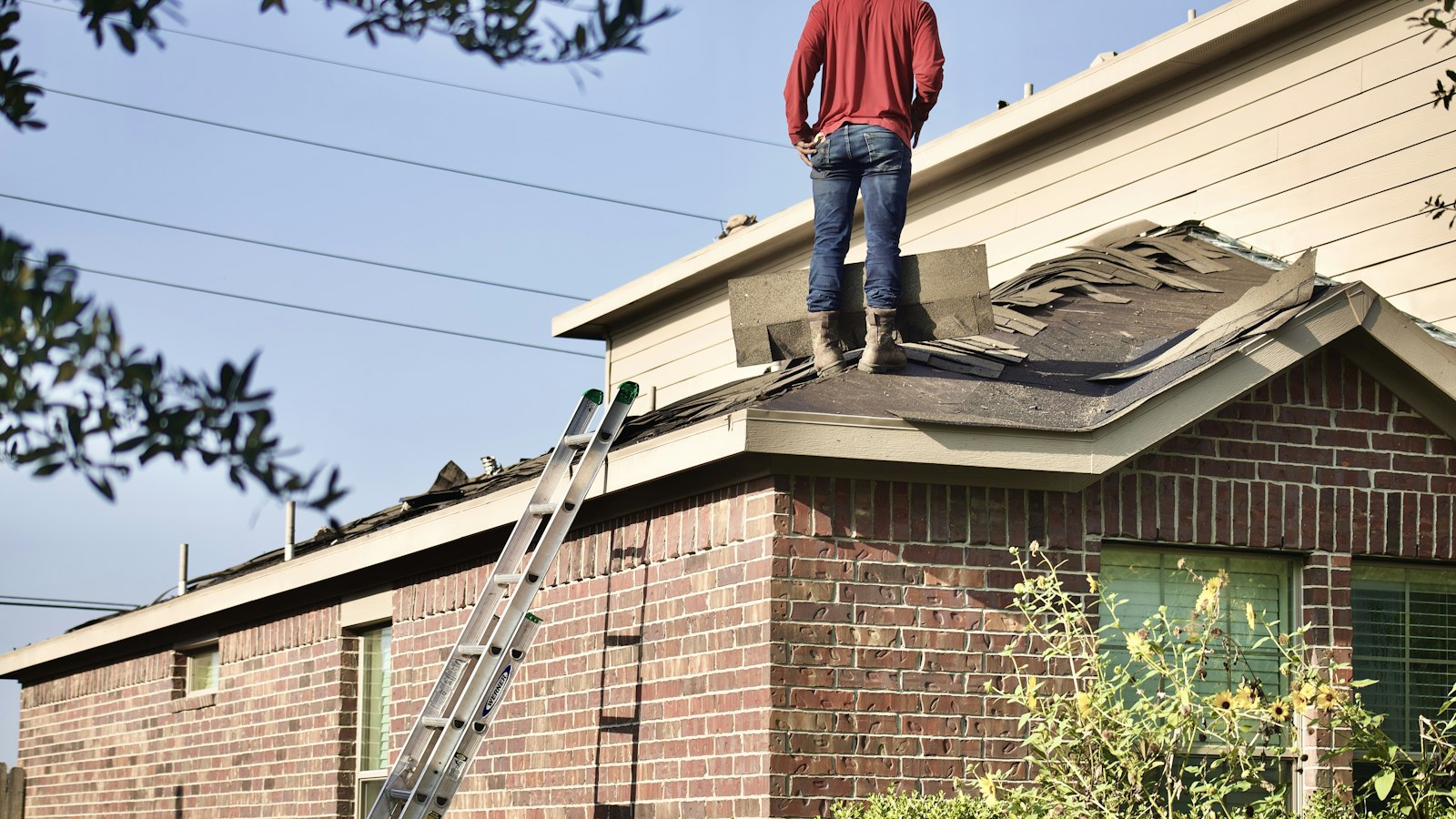
A bundle of standard architectural shingles weighs about 65 to 70 pounds. A square, which is three of those bundles, weighs about 200 to 210. Three tab runs lighter, near 63 a bundle, and the heavy luxury shingles run past 80. Those are sourced figures rather than shop talk, which is harder to say than it should be, because almost nobody publishes this number.
Why the spec sheets do not say how much a bundle of shingles weighs
Start with the documents that ought to carry it. GAF’s Timberline HDZ specification sheet gives the nominal size, the exposure, 64 pieces to a square and 3 bundles to a square, and no weight. GAF’s Royal Sovereign data sheets, imperial and metric both, no weight. TAMKO’s Heritage data sheet and its CSI guide specification, no weight. IKO’s Cambridge technical data sheet, no weight. Malarkey’s product data guide lists bundles per square and shingles per square across the entire shingle line and never once states a pound.
The code report is the sharpest version of it. ICC-ES evaluation report ESR-1389 covers TAMKO’s asphalt shingles, and section 3.1 still says that Table 1 shows installed weights. The metric footnote under that table still carries the conversion factor for pounds per 100 square feet. The weight column itself has been deleted. The sentence describing it and the footnote converting it both survived the edit.
That is why the answers you find to this question vary so much and cite so little. The number is not secret. It is just not where anyone looks.
Two places the number does exist
CertainTeed is the exception among data sheets. The Landmark technical data sheet prints Weight/Square 211 to 225 lb, and gives a reason for the spread: it depends which plant made the shingle. Their Grand Manor sheet prints 418 pounds per square. Same company, same format, the figure simply stated.
The second place is a document nobody opens for a roofing question. Every major manufacturer files an Environmental Product Declaration. It is third party verified, it exists for life cycle accounting, and because mass is the first thing a life cycle study needs, the declaration opens by telling you exactly how many kilograms of shingle go on one square meter of finished roof.
That is the number, in the wrong units. Converting it takes one multiplication:
Pounds per square from a declared mass
pounds per square = kilograms per square meter × 20.48
A kilogram is 2.2046 pounds and a square meter is 10.764 square feet, so one kilogram per square meter is 0.2048 pounds per square foot. A square is 100 square feet, so multiply by 100.
What the declarations say
Six products and one industry average, run through that conversion. The declared mass column is what the manufacturer filed. Everything to the right of it is arithmetic.
| Shingle | Declared mass | Per square | Bundles | Per bundle |
|---|---|---|---|---|
| Owens Corning Supreme, three tab | 9.26 kg/m² | 190 lb | 3 | 63 lb |
| GAF Timberline HDZ | 9.83 kg/m² | 201 lb | 3 | 67 lb |
| Owens Corning Oakridge | 9.93 kg/m² | 203 lb | 3 | 68 lb |
| Owens Corning Duration | 10.12 kg/m² | 207 lb | 3 | 69 lb |
| Industry average, ten makers | 10.6 kg/m² | 217 lb | 3 | 72 lb |
| Malarkey Vista AR | 12.2 kg/m² | 250 lb | 3 | 83 lb |
Malarkey sits at the top because Vista is a polymer modified shingle and genuinely heavier, not because the method drifts. The three tab at the bottom of the list is the lightest thing on a residential roof.
Why the industry figure is the one to trust
The Asphalt Roofing Manufacturers Association published a declaration covering ten manufacturers and at least 75 percent of the North American market. It does not hand you the roof figure. It hands you the parts, which is better, because you can check them.
It lists 4.4 kilograms per square meter of shingle material, an effective coverage of 2.35 square meters of material for every square meter of roof, and a 2 percent scrap rate. Multiply those three and you get 10.55 against the 10.6 they publish.
The 2.35 is the part worth stopping on. A Timberline HDZ shingle is 13 1/4 inches tall and shows 5 5/8 inches of itself once the next course covers the rest. Divide one by the other and you get 2.356. The coverage multiplier buried in a life cycle study is the same overlap ratio a roofer works out standing on the deck, which is a good sign that the study is describing a real roof.
Then the two independent routes meet. The industry declaration converts to 217 pounds a square. CertainTeed, on a data sheet written for a completely different purpose, prints 211 to 225. One of those numbers came out of a life cycle inventory and the other came off a production line, and they agree.
The square gets heavier, the bundle does not
Go back to Grand Manor at 418 pounds a square. Split three ways that is 139 pounds a bundle, and nobody is carrying 139 pounds up a ladder.
So it is not split three ways. When a shingle gets heavier, the manufacturer puts less roof in each bundle rather than more weight. Malarkey’s own product data guide shows the whole pattern inside one brand: Highlander and Vista at three bundles to a square, Legacy at four, Windsor at five. The shingles are getting heavier down that list and the bundles are not.
A bundle is not a unit of product. It is a unit of what one person can carry, held at roughly 60 to 80 pounds for decades while the shingles inside it got heavier and heavier. Which makes bundles per square the most useful number on a listing that nobody reads: four or five bundles to a square is the product telling you it is heavy before any weight is printed anywhere.
What you actually need the weight for
Take a 2,000 square foot footprint at a 6/12 pitch. The pitch multiplier is 1.118, so the roof surface is 2,236 square feet, which rounds up to 23 squares. At 210 pounds a square that is 4,830 pounds of new shingles, a little under two and a half tons.
That figure decides three things, and none of them are the shingle order.
- How it gets delivered. Two and a half tons is a boom truck loading the roof, not a driver walking bundles up a ladder. It is also the difference between one drop and two.
- What the dumpster costs. Roll off containers are priced on a tonnage allowance, not on how full they look. Tearing off one existing layer puts roughly the same 4,830 pounds back in the container, plus the old felt and the nails.
- What the deck is already carrying. 210 pounds a square is 2.1 pounds per square foot. A second layer over the first doubles it, which is why the International Residential Code, at section R908.3.1.1, stops you at two: where the existing roof has two or more applications of any roof covering, all the old material has to come off.
The order itself never needs the weight. Shingles are sold by coverage, so the squares decide the order and the pounds decide the logistics. Work out the squares first and the weight falls out of it.
Work out the squares first
Frequently asked
A standard architectural bundle weighs about 65 to 70 pounds, and bundles of every kind fall between roughly 60 and 80. Three tab sits near 63. The heaviest luxury shingles reach the low 80s and no higher, because once a shingle gets heavy the manufacturer adds bundles per square rather than pounds per bundle.
Between 190 and 250 pounds for most residential shingles, with mainstream architectural products at 200 to 210. CertainTeed prints 211 to 225 pounds per square for Landmark on its technical data sheet, and 418 for Grand Manor. An industry declaration covering ten manufacturers converts to 217 pounds per square.
About 63 pounds. Owens Corning’s environmental declaration puts Supreme, their three tab, at 9.26 kilograms per square meter of finished roof, which converts to 190 pounds per square. Three bundles cover a square, so each one is roughly 63 pounds. It is the lightest asphalt shingle on a residential roof.
Because the shingle is heavy and the bundle has to stay liftable. Malarkey packs Highlander and Vista three bundles to a square, Legacy four and Windsor five. A 418 pound square split three ways would be 139 pounds a bundle, so the square gets divided further instead. Bundles per square is a weight signal in disguise.
About 2.1 pounds per square foot of roof surface, which is 210 pounds per square. A 2,000 square foot house at a 6/12 pitch has 2,236 square feet of roof, or 23 squares, so the new shingles weigh about 4,830 pounds. A second layer over the first doubles that, and the code does not allow a third.