
Measure the lawn in feet, multiply length by width, and add about 10 percent. That is the whole answer. A 40 by 25 foot lawn is 1,000 square feet, so you order about 1,100 square feet, which is 110 pieces at the 10 square feet a piece most growers cut.
Everything below is about getting that first number right, because the 10 percent is easy and the measuring is where orders go wrong.
Measure the lawn, not the yard
The figure you want is the grass, and only the grass. Measure to where it actually stops rather than to the fence or the property line, and leave out everything you are not turfing.
- Beds, borders and the mulch ring around a tree.
- The patio, the path, the driveway and the apron in front of the garage.
- The shed, the deck footprint and anything else standing on ground that used to be lawn.
Pace it if you have no tape. A comfortable adult stride is close enough to three feet for an estimate, and being a few feet out on a lawn this size is what the allowance is for.
An awkward shape is two or three simple ones
Almost no lawn is a rectangle, and almost every lawn is a few rectangles pushed together. Split it, measure each piece, add the answers. Do not average a long side against a short one, because that quietly loses area at every corner.
| Shape | Area |
|---|---|
| Rectangle | length × width |
| Triangle | base × height ÷ 2 |
| Circle | 3.14 × radius × radius |
| Half circle | the circle, halved |
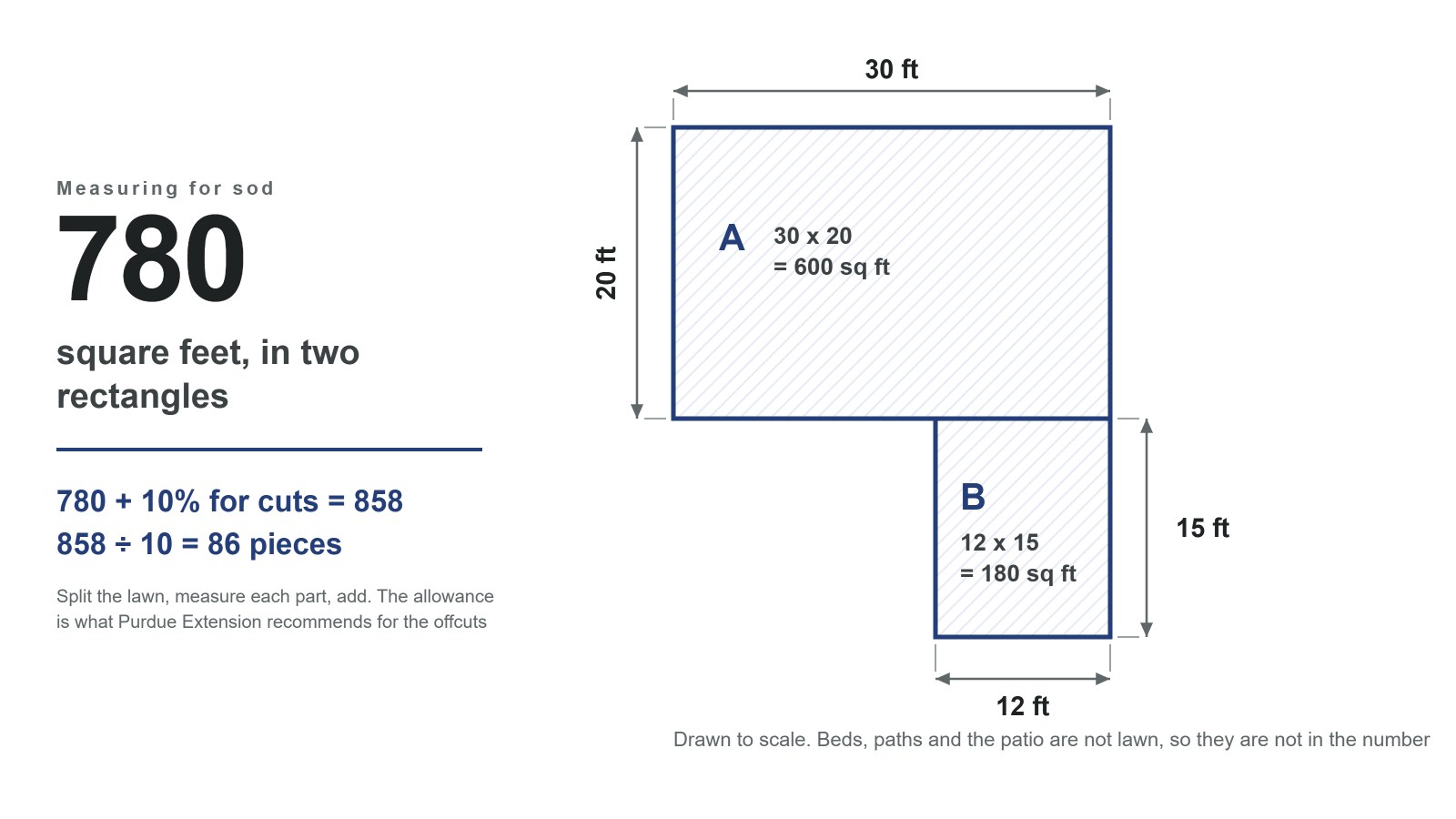
An L-shaped back lawn that runs 30 by 20 feet along the house and turns into a 12 by 15 foot leg beside the garage is 600 plus 180, so 780 square feet. Add the allowance and that is 858, which rounds to 86 pieces.
The whole calculation
( area in sq ft × 1.10 ) ÷ sq ft per piece = pieces
Round up. Ten square feet a piece is the common roll; confirm it with your grower, because the cutting machine sets it.
Common lawn sizes
Pieces are at 10 square feet each. The pallet column is what you would need if a pallet holds 450 to 500 square feet, rounded up, which is why the last row is a range rather than a number.
| Lawn | Area | With 10 percent | Pieces | Pallets, roughly |
|---|---|---|---|---|
| 20 x 25 ft | 500 sq ft | 550 sq ft | 55 | 2 |
| 40 x 25 ft | 1,000 sq ft | 1,100 sq ft | 110 | 3 |
| 50 x 40 ft | 2,000 sq ft | 2,200 sq ft | 220 | 5 |
| 100 x 50 ft | 5,000 sq ft | 5,500 sq ft | 550 | 11 to 13 |
Why 10 percent, and when 5 will do
The allowance is for cutting, not for breakage. Sod does not shatter in transit the way brick does. What you lose is the offcut left behind every time a piece meets a curve, a bed, a path or a tree ring, so it tracks how complicated the edge is rather than how big the lawn is.
Purdue Extension recommends ordering about 10 percent more than you expect to need, which covers both measurement error and those cuts. Mississippi State Extension suggests about 5 percent. Both are right for different lawns: a plain rectangle with straight edges wastes very little, and a lawn cut up with curved beds and three tree rings will use every bit of ten.
Err upward rather than downward. A few spare pieces tuck into a gap or patch a thin spot. Coming up short means a second delivery for a handful of sod, and the new pieces will have had a different week to the ones already down.
Order in square feet, not in pallets
A pallet is not a unit of measure. Mississippi State puts a typical pallet at 450 to 500 square feet, Virginia gives a range of 450 to 700, and Purdue gives about 50 square yards, which is 450. So “three pallets” is somewhere between 1,350 and 2,100 square feet depending on whose field it came from.
Growers also tend to quote by the square yard while you measured in feet. One square yard is 9 square feet. Give them the square footage and let them convert; that way the number that matters is yours.
Weight decides how the day goes. Virginia gives dry sod at 20 to 25 pounds per square yard and wet sod at 30 to 40, and Mississippi State notes that a 450 square foot pallet may weigh as much as a ton. A 2,000 square foot lawn is four pallets and roughly four tons arriving at once, and it all wants to be on soil the same day.
Put your own measurements in
Frequently asked
About 1,100 square feet of sod, because the order carries roughly 10 percent over the measured area to cover the cuts. At the 10 square feet a piece most growers cut, that is 110 pieces, or near enough three pallets.
Split it into simple shapes and add the answers. A rectangle is length times width, a triangle is base times height divided by two, and a circle is 3.14 times the radius squared. Measure to where the grass actually stops, and leave out beds, paths and anything else you are not turfing.
It depends on the grower, which is exactly why you should order in square feet. Mississippi State Extension puts a typical pallet at 450 to 500 square feet, Virginia Cooperative Extension gives a range of 450 to 700, and Purdue gives about 50 square yards, which is 450.
Purdue Extension recommends about 10 percent over your measured area, which covers both measurement error and the offcuts from cutting around corners, beds and edges. Mississippi State suggests about 5 percent. Use five on a plain rectangle with straight edges and ten on anything with curves.
That depends on how the grower cuts it. At 10 square feet a piece, a 450 square foot pallet holds about 45 pieces. At the 3 square feet of a small slab it holds about 150. Ask for the piece size along with the pallet size, because neither one is standard.
Enough to matter. Mississippi State Extension notes that a 450 square foot pallet may weigh as much as a ton, and Virginia gives dry sod at 20 to 25 pounds per square yard, rising to 30 to 40 when it is wet. Plan for how it comes off the truck before it arrives.