
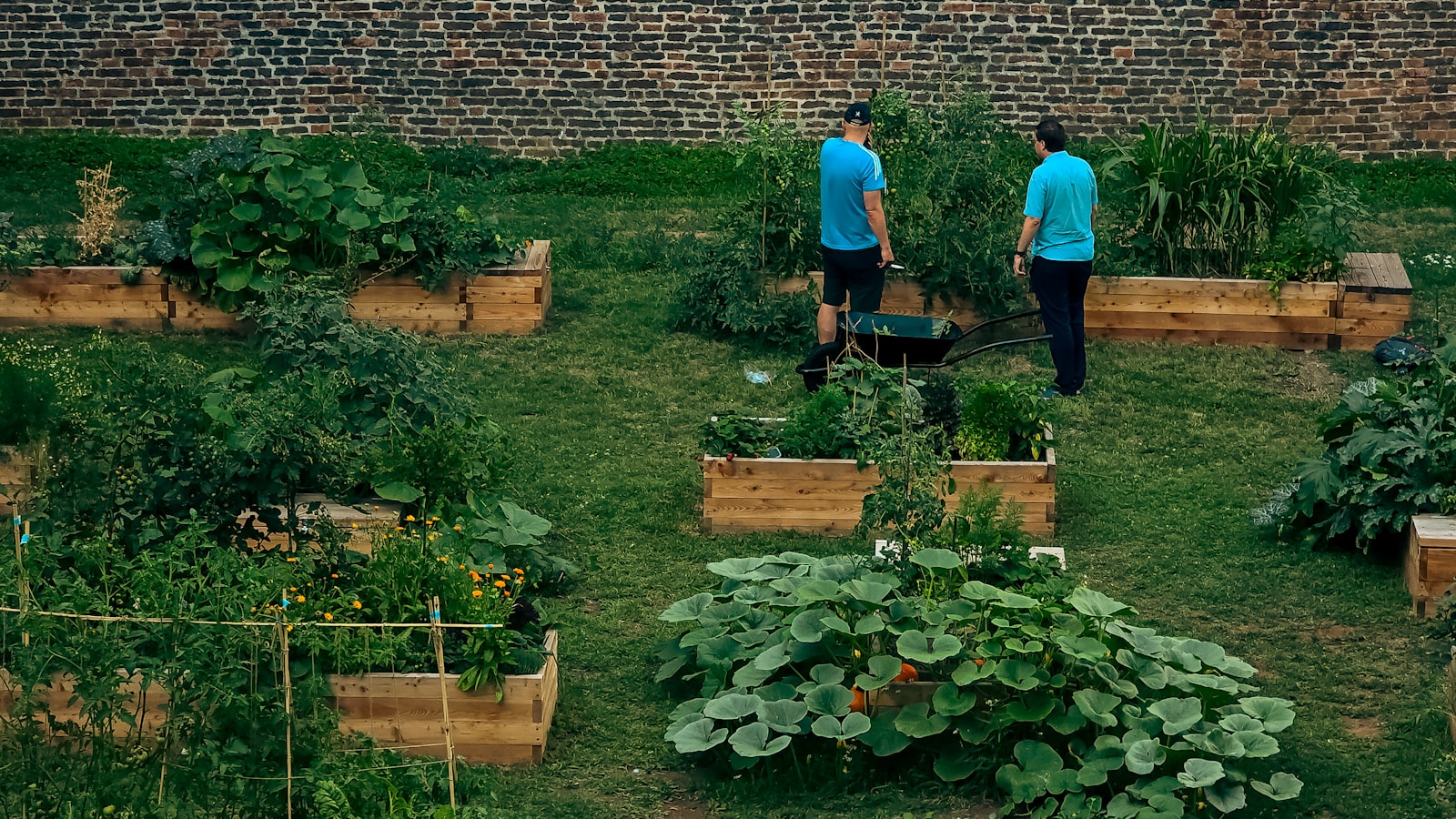
You need 1.24 cubic yards of soil for a raised bed measuring 8 by 4 feet and filled 12 inches deep. That is about 33.6 cubic feet, 34 bags of one cubic foot each, and roughly 1.51 tons of material, which is a great deal more than most people picture when they look at an empty frame.
How much soil for a raised bed, and why the answer surprises people
Soil volume
cubic yards = length × width × ( depth in inches ÷ 12 ) ÷ 27
8 × 4 × 1 = 32 cubic feet, plus a 5% allowance, is 1.24 cubic yards
A bed that is easy to step over and easy to reach across still swallows over a cubic yard. The reason the figure feels wrong is that we judge the bed by its footprint, 32 square feet, which sounds small, while the soil is priced by volume, and depth is doing most of the work.
Depth is the whole decision
On the same 8 by 4 frame, the depth you fill to changes the order in a straight line:
- 6 inches: 0.62 cubic yards, 16.8 cubic feet, 0.76 tons
- 8 inches: 0.83 cubic yards, 22.4 cubic feet, 1.01 tons
- 10 inches: 1.04 cubic yards, 28 cubic feet, 1.26 tons
- 12 inches: 1.24 cubic yards, 33.6 cubic feet, 1.51 tons
- 18 inches: 1.87 cubic yards, 50.4 cubic feet, 2.27 tons
Doubling from 6 inches to 12 doubles the order exactly. There is no efficiency to find in the geometry, so the depth question has to be answered on what you are growing rather than on what you can afford.
What each depth is actually good for
- 6 to 8 inches suits lettuce, herbs, radishes and most leafy greens, provided the bed sits on soil the roots can push into if they want more.
- 12 inches is the general-purpose depth and handles almost everything, including tomatoes, peppers, beans and squash.
- 18 inches is for long root crops, or for a bed sitting on a hard surface where nothing can grow downward past the frame.
That last point matters more than the crop does. A bed on open ground can be shallower, because roots continue into the soil beneath. A bed on concrete, decking or heavy compacted clay is the entire root zone, and it needs the full depth.
Do not fill the whole thing with topsoil
The calculation above gives total volume. It does not follow that all of it should be bought topsoil, and for a deep bed it should not be.
Purchased topsoil on its own tends to compact into a dense layer that drains poorly. A working raised bed mix is usually topsoil blended with compost and something to keep it open, and for the bottom third of a deep bed plenty of gardeners use coarser or cheaper material entirely: branches, leaves, or partially finished compost that will break down over the first season.
The saving is in the bottom third. On an 18 inch bed, the lower 6 inches is 0.62 cubic yards, half the volume of an entire 12 inch bed. Filling that with material you already have turns an 18 inch bed into a 12 inch order.
Topsoil, garden soil and compost are not the same order
The word on the bag matters, because these are priced differently and behave differently, and a bed filled entirely with the wrong one will disappoint for a whole season before anyone works out why.
- Screened topsoil is mineral soil with the stones and debris taken out. It is the bulk of the volume and the cheapest per yard, and on its own it compacts.
- Compost is decomposed organic matter. It feeds the bed and keeps the structure open, and it is far too rich and too light to fill a bed with by itself.
- Bagged “garden soil” or “raised bed mix” is usually the two already blended, which is convenient and costs considerably more per cubic foot than buying the components.
A common working ratio is somewhere around half to two-thirds topsoil with the rest compost, adjusted for what you are growing and what your existing ground is like. Rutgers Cooperative Extension makes the point from the other side in its fact sheet on soil for raised beds: beds filled with organic growing media alone tend to lose productivity after a few seasons, which is what the mineral fraction is there to prevent. Whatever mix you land on, calculate the total volume first and split it afterward. Volume is volume, and the bed does not care which bag it came out of.
Measuring a bed that is not a rectangle
Not every bed is 8 by 4. For an L-shape or a bed that wraps a corner, split it into rectangles, work each one out separately at the same depth and add the results. For a circle, take the radius, square it, multiply by 3.14, and use that as the area in the same formula.
For a genuinely irregular shape, the practical trick is to take the average width across several points rather than trying to be exact. Soil is not sold in increments fine enough to reward more precision than that, and the allowance absorbs the difference.
It settles, so order for after the settling
Fresh soil and compost are full of air and drop noticeably in the first few weeks, and again over the first winter. A bed filled exactly level on the day it is built will be visibly below the rim by spring.
Two habits deal with it. Fill slightly proud of the frame and water it in thoroughly rather than leaving it fluffy, and plan on topping up with compost each spring, which is what you would be doing anyway to feed the bed. The 5 percent allowance in the figures above covers spillage and measurement slop, not settlement, so treat those two separately.
More than one bed, and when to stop buying bags
Beds multiply quickly, and so does the crossover point where bagged soil stops making sense.
- 1 bed: 1.24 cubic yards, 1.51 tons
- 2 beds: 2.49 cubic yards, 3.02 tons
- 3 beds: 3.73 cubic yards, 4.54 tons
- 4 beds: 4.98 cubic yards, 6.05 tons
One bed is 34 bags, which is already a full car load and a long afternoon. Four beds is around 135 bags, and at that point you are handling three tons of soil one bag at a time for the privilege of paying several times the bulk price. Bulk delivery is dumped in one pile and moved with a wheelbarrow, and the crossover is somewhere around a single cubic yard for most people.
Bed size moves it too: a 4 by 4 bed at 12 inches is 0.62 cubic yards, and a 12 by 4 is 1.87. If you are still deciding on dimensions, work out the soil before committing to the timber, because the frame is usually the cheaper half of the project.
The topsoil calculator takes the bed dimensions and returns yards, bags and tons together. For the layer that goes on top once it is planted, the mulch calculator covers it, and the gravel calculator handles any drainage material going underneath.
Work out your own beds
Frequently asked
An 8 by 4 foot bed filled 12 inches deep takes about 1.24 cubic yards, which is 33.6 cubic feet, 34 one cubic foot bags, or roughly 1.51 tons.
Twelve inches suits almost everything. Six to eight is enough for greens and herbs if the bed sits on open soil, but a bed on concrete or decking is the whole root zone and wants the full depth.
About 34 bags of one cubic foot at 12 inches deep. That is already a full car load, and at more than one bed bulk delivery is usually cheaper and much less work.
No. Bought topsoil alone compacts and drains poorly, so blend it with compost. On a deep bed the bottom third can be branches, leaves or rough compost, which on an 18 inch bed saves about 0.62 cubic yards.
Fresh soil and compost hold a lot of air and settle over the first few weeks and again through winter. Fill slightly proud of the frame, water it in properly rather than leaving it loose, and top up with compost each spring.