
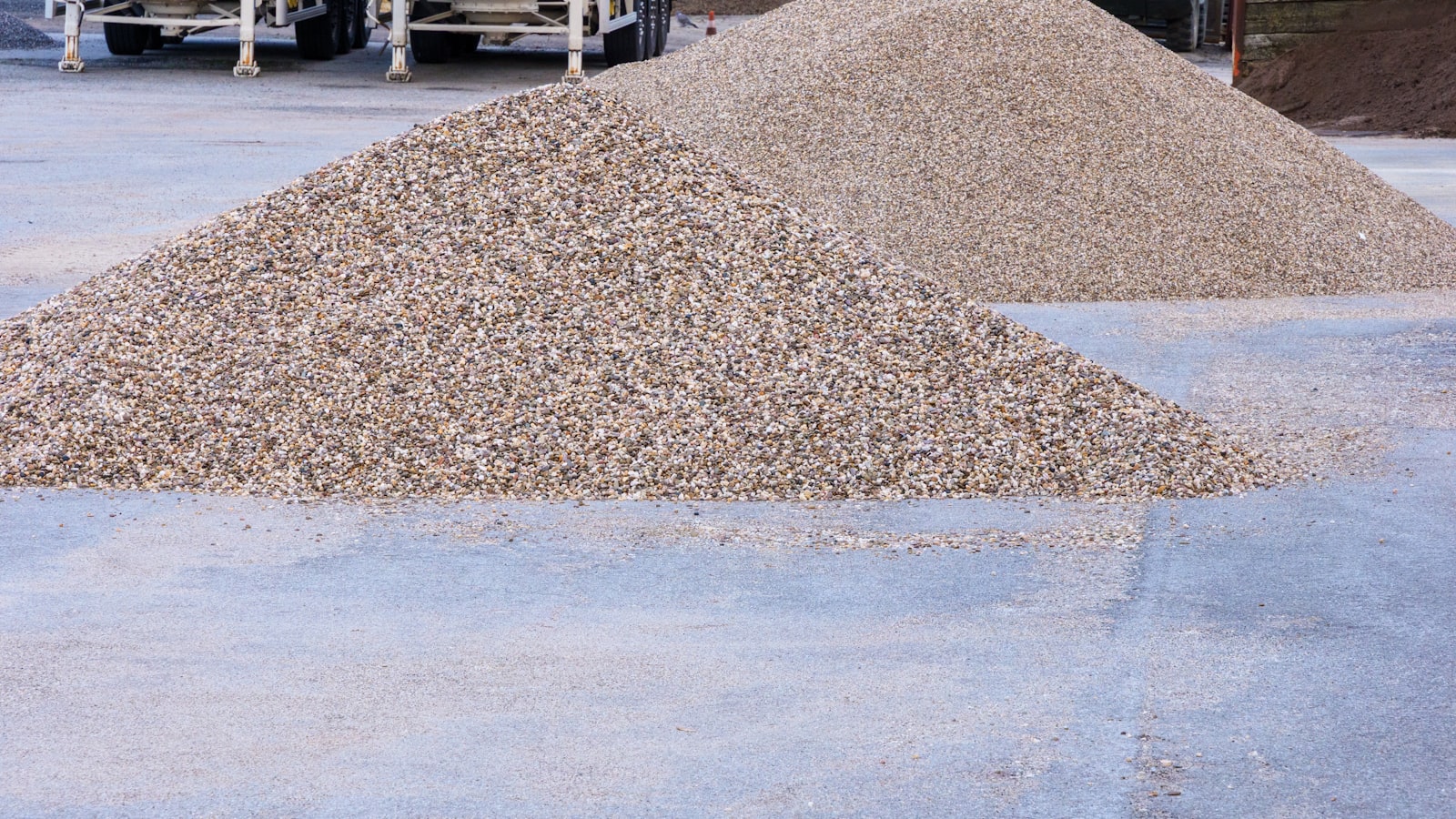
There are about 1.42 tons of gravel in a yard, meaning a cubic yard, at a typical density of 105 pounds per cubic foot. The word doing the work there is “about”: the same volume runs from 1.28 to 1.69 tons depending on the stone and the weather, and that spread is wide enough to matter on any order big enough to need a truck.
Why tons of gravel in a yard is not one number
A cubic yard is a fixed volume, 27 cubic feet. A ton is a fixed weight. The conversion between them is density, and gravel does not have one density, it has a range.
Volume to weight
tons = cubic yards × 27 × density in lb/cu ft ÷ 2,000
At 105 lb per cubic foot, one cubic yard is 1.42 tons
- 95 lb per cubic foot: 1.28 tons a yard. Loose, larger, lighter stone.
- 105 lb per cubic foot: 1.42 tons. The usual working figure.
- 115 lb per cubic foot: 1.55 tons. Dense graded material with fines in it.
- 125 lb per cubic foot: 1.69 tons. Wet, or already compacted.
From lightest to heaviest that is a 32 percent difference in weight for exactly the same hole in the ground. If you are buying by the ton and estimating by the yard, that gap is the whole risk in the order.
What moves the density
Stone size and grading
Uniform, single-size stone has large voids between the pieces and weighs less per yard. Dense graded material mixes sizes so the small pieces fill the gaps between the large ones, leaving less air and more rock in the same volume. This is why crusher run is heavier than clean drainage stone even though both are gravel.
Moisture
Water fills voids and weighs something. A pile that sat through a wet week is genuinely heavier than the same pile in August, and you are charged for the water. Gravel bought by weight after heavy rain is the classic way to pay more for less.
Whether it is compacted
The figures above are loose delivered material. Once it is spread and plate-compacted it occupies noticeably less volume, which is why an order that looked generous in the pile can look thin on the ground. Order against the loose figure and expect the finished layer to settle.
What that does to a driveway
A 40 by 12 foot driveway, with a 10 percent allowance included, at the depths people actually use:
- 2 inches: 3.26 cubic yards, 4.62 tons, about $194 of material.
- 3 inches: 4.89 cubic yards, 6.93 tons, about $291.
- 4 inches: 6.52 cubic yards, 9.24 tons, about $388.
- 6 inches: 9.78 cubic yards, 13.86 tons, about $582.
Depth is the only lever with real money on it. Going from 3 inches to 6 doubles the order and adds close to $300 on a driveway this size. Getting the depth right for the job matters far more than shaving the density estimate.
How deep, by what it is for
The right depth is decided by what will drive or sit on it, and by what is underneath.
- Paths and light foot traffic: 2 inches over a stable base is usually enough.
- A patio or paver base: around 4 inches of compacted aggregate, with the bedding layer on top of that rather than instead of it.
- A residential driveway: 4 to 6 inches, more where the ground is soft or drainage is poor.
- Anything carrying regular heavy vehicles: deeper again, and laid in compacted lifts rather than one thick pour of stone.
Deep layers should go down in stages. Spreading six inches at once and running a compactor over the top compacts the top and leaves the bottom loose, which is how a driveway develops ruts in its first winter. Three inches at a time, compacted before the next goes on, is the standard practice and it is worth the extra pass.
What sits under the gravel matters as much as the gravel. On soft or clay ground, a geotextile fabric between soil and stone stops the two mixing, which is the slow failure that makes a driveway seem to swallow material year after year. Without it you are topping up forever; with it the layer you ordered stays the layer you have.
Buying by the ton or by the yard
Suppliers quote both, and which one you get depends on the yard rather than on the material. Neither is wrong, but you need to know which you are being quoted in before comparing two prices.
Work in volume, convert at the end
Volume is what the job consumes, and it does not change with the weather. Measure the area, settle the depth, and get to cubic yards first.
Volume from the space you are filling
cubic yards = length × width × ( depth in inches ÷ 12 ) ÷ 27
40 x 12 at 3 inches is 4.44 cu yd before any allowance
Ask for the density of the actual product
Convert to tons only at the point of ordering, and ask what density they use for the specific material rather than applying a general figure. They will know it, and it is the number their own weighbridge is going to agree with. A guessed density on a twenty ton order is a several hundred dollar guess.
Add the allowance before you order, not after
Ten percent covers settlement, the uneven ground you did not measure, and the material that ends up outside the lines. It is a rounding error on a small job and a second delivery charge on a large one, and a second delivery always costs more than the stone in it.
The gravel calculator returns cubic yards and tons together from the same measurements, so you can order in whichever unit you are quoted. For the bedding layer that goes on top of a base like this, the sand calculator covers it, and the concrete calculator handles anything being poured instead of laid.
Work out your own load
Frequently asked
About 1.42 tons at 105 pounds per cubic foot, which is the usual working figure. The realistic range is 1.28 tons for loose lightweight stone up to 1.69 tons for wet or compacted dense graded material.
Roughly 0.7 cubic yards at 105 pounds per cubic foot, since a yard is about 1.42 tons. Ask your supplier for the density of the specific product before converting a large order, because it varies by more than 30 percent across common materials.
A 40 by 12 foot driveway takes about 4.89 cubic yards, or 6.93 tons, at 3 inches deep with a 10 percent allowance. At 6 inches it is 9.78 cubic yards and 13.86 tons.
Water fills the voids between the stones and adds weight without adding volume. The same cubic yard can go from around 1.42 tons dry to 1.69 wet, so buying by weight after heavy rain means paying for water.
Four to six inches for a residential driveway, more where the ground is soft. Lay deep layers in stages and compact each one, since compacting six inches in a single pass firms the top and leaves the bottom loose.