
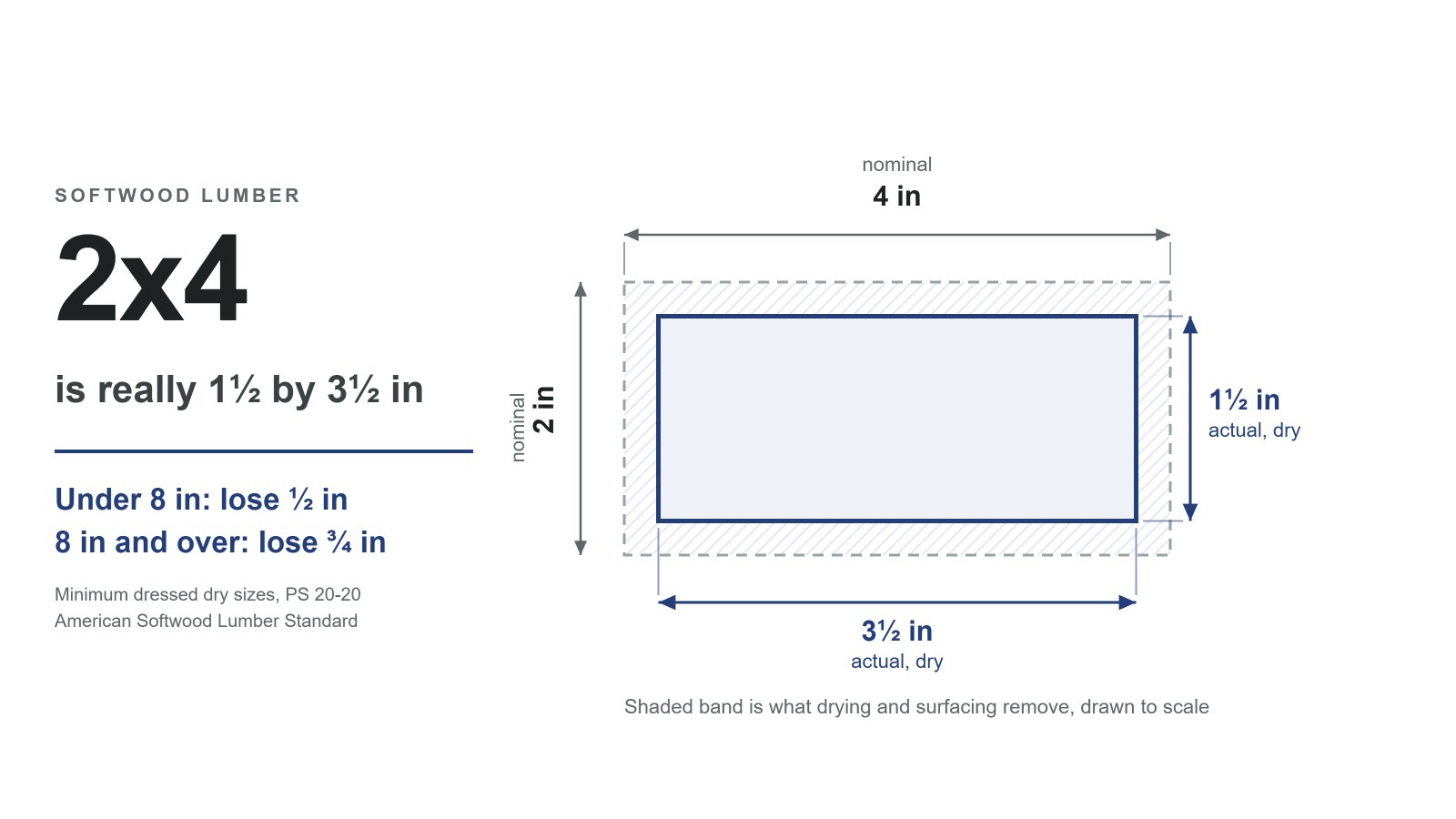
A nominal 2x4 measures 11⁄2 inches by 31⁄2 inches. Not two by four, and not a mistake at the mill either. The number printed on the tag is roughly the size the board was when it came off the saw, and the size in your hand is what survived drying and planing.
Every softwood size works the same way, and the shortfall is not a constant. A 2x4 loses half an inch across its width, but a 2x8 loses three quarters. That inconsistency is the part that catches people out, so here is the whole table before the explanation.
Nominal and actual widths
These are the minimum dressed sizes set by Voluntary Product Standard PS 20-20, the American Softwood Lumber Standard, published by the US Department of Commerce. They apply to boards and to dimension lumber alike.
| Nominal width | Actual, dry | Actual, green |
|---|---|---|
| 2 in | 11⁄2 in | 19⁄16 in |
| 3 in | 21⁄2 in | 29⁄16 in |
| 4 in | 31⁄2 in | 39⁄16 in |
| 5 in | 41⁄2 in | 45⁄8 in |
| 6 in | 51⁄2 in | 55⁄8 in |
| 8 in | 71⁄4 in | 71⁄2 in |
| 10 in | 91⁄4 in | 91⁄2 in |
| 12 in | 111⁄4 in | 111⁄2 in |
| 14 in | 131⁄4 in | 131⁄2 in |
| 16 in | 151⁄4 in | 151⁄2 in |
Nominal and actual thicknesses
Thickness follows its own column in the same standard. Pair the two tables and you have any size you are likely to buy: a 2x8 is the 2 inch thickness row with the 8 inch width row, so 11⁄2 by 71⁄4 inches dry.
| Nominal thickness | Actual, dry | Actual, green |
|---|---|---|
| 1 in | 3⁄4 in | 25⁄32 in |
| 11⁄4 in | 1 in | 11⁄32 in |
| 11⁄2 in | 11⁄4 in | 19⁄32 in |
| 2 in | 11⁄2 in | 19⁄16 in |
| 3 in | 21⁄2 in | 29⁄16 in |
| 4 in | 31⁄2 in | 39⁄16 in |
The rule worth memorizing
Under 8 in nominal, subtract 1⁄2 in. 8 in and over, subtract 3⁄4 in.
Dry lumber only. It holds for every width from 2 through 16, and for thicknesses up to 4 in.
Why the board shrank
Two things happen to a board between the log and the rack, and each one takes material away.
- Drying. Wood gives up water and contracts across the grain as it does. A board sawn to a full two inches does not stay two inches once the moisture leaves it.
- Surfacing. The dried board is then planed smooth on all four faces, which is what makes it straight enough to build with. Planing cannot happen without removing material.
The nominal figure stuck around because that is what the trade had always called it. Rather than renaming every size, the standard fixed what the finished board must actually measure, which is why a 2x4 is reliably 11⁄2 by 31⁄2 and not merely approximately so.
Dry, green, and the 19 percent line
The standard draws the line at moisture content. For lumber under a nominal 5 inches thick, dry means seasoned to 19 percent moisture content or less, and green means anything above that. Green stock is allowed to be slightly fatter because it has not finished shrinking.
The difference is small, a sixteenth on narrow widths and a quarter on wide ones, but it is not academic. Green 2x10 joists measure 91⁄2 inches on delivery and will settle toward 91⁄4 as they dry in place. If you are scribing trim or setting a ledger to a fixed height, measure the board in front of you rather than trusting a table.
Kiln dried stock is usually stamped KD or S-DRY, and material dried to 15 percent is stamped MC15 or KD15. Green material carries S-GRN. If the stamp is missing because the end was cut off, assume nothing and measure.
Where the missing half inch actually bites
Most of the time the nominal name is harmless shorthand. These are the moments it is not.
- Wall thickness. A 2x4 stud wall is 31⁄2 inches of framing, not 4. Add half inch drywall to both faces and the finished wall is 41⁄2 inches. Door jambs are sold to match that number, so getting it wrong means a jamb that does not reach.
- Built up headers. Two 2x material pieces are 3 inches thick, not 4, which leaves a half inch short of a 2x4 wall. That gap is why a half inch plywood or OSB spacer goes in the middle.
- Deck boards. A 5/4 deck board is 1 inch thick, and a nominal 6 inch board covers 51⁄2 inches before you allow for the gap between boards. Counting on 6 inches of coverage will leave you short.
- Stacked courses. Anything you build by stacking 2x material compounds the error. Six 2x10s laid flat are 9 inches tall, not 12.
The calculators on this site already work in actual dimensions, so you do not have to convert anything before entering a size.
Size your own deck
Frequently asked
A dry, surfaced 2x4 measures 11⁄2 inches by 31⁄2 inches. Green 2x4 stock is allowed to be slightly larger, at 19⁄16 by 39⁄16 inches, because it has not finished shrinking. Both figures are set by PS 20-20, the American Softwood Lumber Standard.
11⁄2 inches by 71⁄4 inches when dry. Note that a 2x8 loses three quarters of an inch off its nominal width while a 2x4 loses only a half. Every width of 8 inches and over drops 3⁄4 in, and everything narrower drops 1⁄2 in.
11⁄2 inches by 51⁄2 inches dry, or 19⁄16 by 55⁄8 inches green. A 2x6 wall therefore frames at 51⁄2 inches deep, which is the figure to use when sizing insulation for it.
Because the nominal name describes the board near the point it was sawn, before two things removed material from it. Drying shrinks wood across the grain, and surfacing planes all four faces smooth. The trade kept the old name and the standard fixed the finished size instead.
Yes. The standard defines dry lumber as seasoned to 19 percent moisture content or less, and green as anything wetter. Green boards are permitted to be a sixteenth of an inch larger on narrow widths and a quarter of an inch larger on widths of 8 inches and over, since they will shrink toward the dry size in place.