
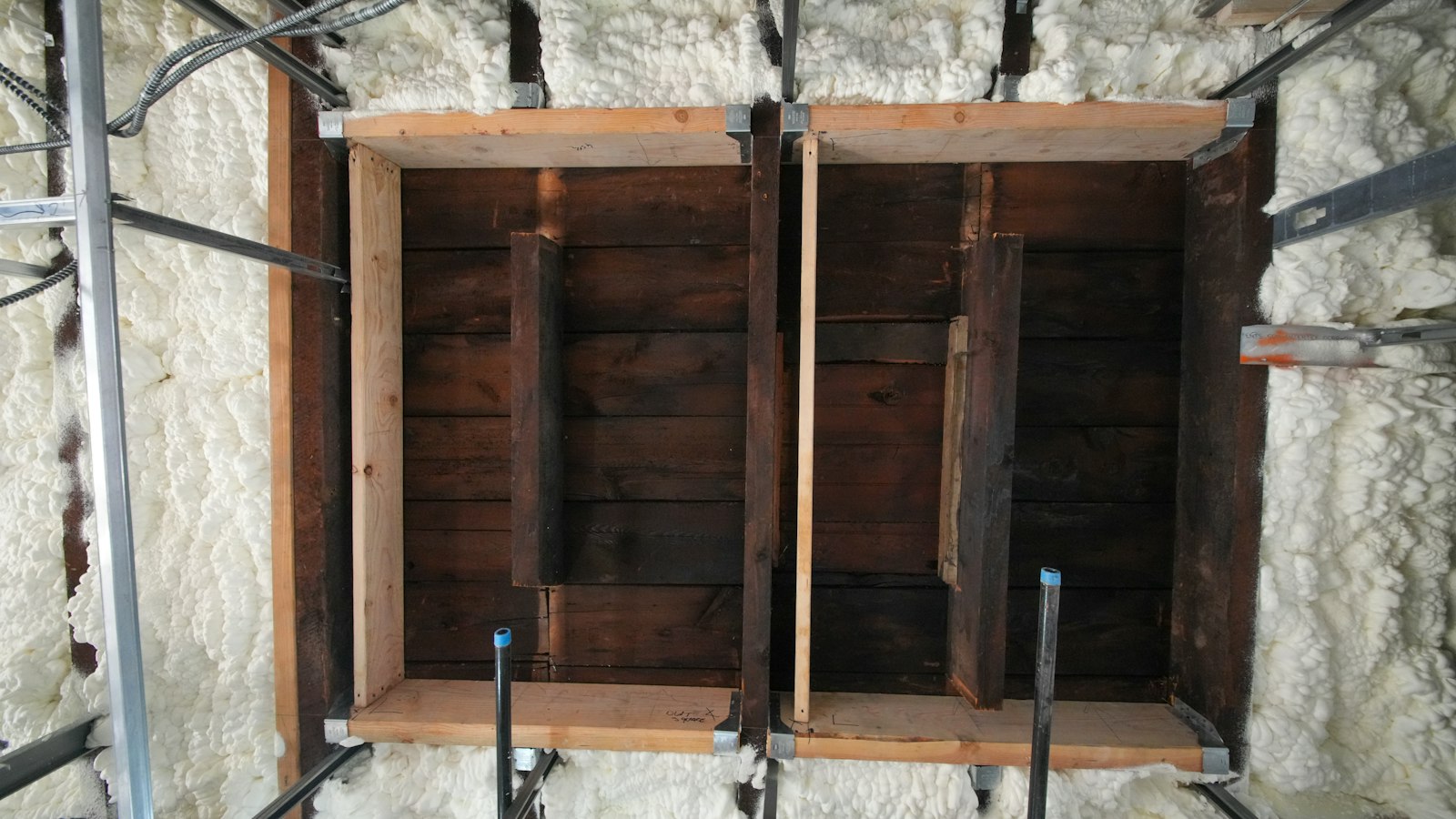
Spray foam is the default answer for a rim joist and mostly the right one, because it insulates and seals in the same pass. What decides whether it works is not in the advice, it is on the product sheet: a temperature the job has to be above, a thickness each pass has to stay under, and a nozzle that goes off in thirty seconds. Those three turn a straightforward afternoon into a bad one more often than anything else.
Open cell or closed cell
Both are approved at a rim joist and they behave differently enough that the choice is not about price.
| Open cell | Closed cell | |
|---|---|---|
| Density | About 0.5 lb/cu ft | About 2 lb/cu ft |
| R per inch | 3.5 to 3.8 | 7 to 9 |
| Thickness to be an air barrier | 51⁄2 in | 11⁄2 in |
| In a 2x10 bay | Fits, but only just | Comfortable |
That air barrier row is the one that decides it. Sealing is most of why foam is used here at all, and open cell needs nearly four times the depth to do it. A 2x10 bay is 91⁄4 inches deep so 51⁄2 inches physically fits, but you are now spending four inches of cavity on a job the other product does in one and a half.
There is a second reason, and it is climate specific. Building Science Corporation gives both foams acceptable results at the rim, with one qualifier: open cell may need added vapor and condensation control in DOE climate zone 6 and higher. In a cold region that turns a one product job into a two product job.
The temperature problem nobody plans for
DuPont’s instructions for spraying a rim joist with Froth-Pak are specific. The kit contents want to be between 70 and 120 degrees Fahrenheit, best at 75 or warmer. Ambient and surface temperatures should be 65 degrees or above.
Now think about when people do this job. They do it in winter, because that is when the floor above is cold and the draft is obvious. And the surface being sprayed is the one piece of wood in the house with the outdoors on the other side of it, which is to say the coldest surface available.
So the season that creates the motivation is the season the product is least happy in. The fix is not complicated, it is just a step people skip: warm the basement for a day beforehand, keep the cylinders somewhere heated rather than in the van overnight, and check the rim itself with an infrared thermometer rather than the room.
Two inches a pass, which makes three inches two passes
Froth-Pak can be applied up to two inches thick in one pass. That matters because the thickness you are aiming for is usually more than two: the exposed foam limit at a rim joist is 31⁄4 inches, and in a cold zone you want to be near it.
So plan for two passes and let the first go off before the second. In cool weather or on an awkward surface DuPont suggests a flash coat first, a very thin layer about a quarter inch thick, left until it is tack free, which takes about a minute. Then build up from there.
The other reason to spray thin is that the newer formulation expands more than the old one, so a pass that looks right going on keeps growing. DuPont’s own advice is faster passes, and that the first coat does not need to be as thick to reach the same final thickness.
The thirty second nozzle
This is the rule that catches people out on a rim joist specifically, and it is worth reading twice. If you stop spraying for more than thirty seconds, the nozzle is finished and you fit a new one. On the high density product it is fifteen seconds.
A rim joist is thirty to ninety separate bays. Between them you are stepping sideways, moving a ladder, shifting a hose past a duct, finding the next gap behind a pipe. Those pauses are exactly the shape of the job, and each one over thirty seconds costs a nozzle.
The way round it is to stop treating the bays as separate. Work along the rim in a continuous run, clear the obstacles out of the way before you start rather than as you reach them, and have the next few bays already prepped. Count the nozzles in the kit before you open it, because that number is the real limit on how many stops you get.
What the yield figure is actually telling you
A kit is rated in board feet, which is a square foot at an inch thick. DuPont lists 200 board feet for the small kit and 630 for the large one, and both figures are labelled theoretical.
Theoretical is not marketing hedging, it is defined on the sheet: the calculation is performed in perfect laboratory conditions, and it does not account for blowing agent loss or for variations in application. It is also measured at one inch thick, so spraying at two inches does not halve your coverage, it halves it and then takes some more off.
Plan on getting meaningfully less than the number on the box, and do not plan on finishing with a part used kit either. Once the chemicals have been through the hose the clock is running on the whole thing.
How many kits is your rim joist
This is not a caulk gun job
Two component foam is a chemical reaction happening a few inches from your face in a basement. DuPont’s own list for spraying a rim joist is eye protection, Tyvek hooded coveralls, nitrile gloves and a respirator with a P100 organic vapor cartridge, with the dispenser held at least six inches from the surface.
Ventilate while you work and for at least an hour afterwards, and do not go back in without the respirator during that hour. Put out every flame source first, which in a basement usually means the water heater and the furnace.
Prep is part of the safety story too: remove all water, oil, dust, dirt or debris before you start. A dirty rim is also a rim the foam will not stick to properly, so the two requirements point the same way.
When to hand it over
Kits make sense for a run you can finish in one session with one set of gear. The arithmetic turns against you when the rim is long enough to need several kits, when the basement cannot be brought up to temperature, or when the bays are so broken up by services that the nozzle count becomes the binding constraint.
At that point a contractor with a proper rig is not just faster, they are working with equipment that does not punish a thirty second pause. The detail itself is worth understanding either way, because it is what tells you whether the job has been done properly when you look at it afterwards.
Frequently asked
Closed cell, in most cases. It reaches air barrier performance at 11⁄2 inches of finished thickness where open cell needs 51⁄2, and it carries roughly twice the R per inch. Building Science Corporation accepts both at the rim but notes that open cell may need added vapor and condensation control in DOE climate zone 6 and higher.
DuPont asks for ambient and surface temperatures of 65 degrees Fahrenheit or above, with the kit contents between 70 and 120 degrees and ideally at 75 or warmer. The rim joist is the coldest surface in the basement, so warm the space for a day first and check the wood itself rather than the room.
At least two. Froth-Pak can be applied up to two inches thick in a single pass, so anything approaching the 31⁄4 inch exposed foam limit is built up in layers. In cool weather or on an awkward surface, start with a flash coat about a quarter inch thick and let it go tack free, which takes about a minute.
Less than the box says. DuPont rates the small kit at 200 board feet and the large one at 630, and labels both theoretical, which it defines as calculated in perfect laboratory conditions without accounting for blowing agent loss or variations in application. The figures are also measured at one inch thick, so spraying thicker costs more than the simple division suggests.
Because it is meant to. If spraying stops for more than thirty seconds the nozzle has to be replaced, and on the high density product it is fifteen. A rim joist is dozens of separate bays with a pause between each one, so the fix is to work in continuous runs and clear the obstacles before you start rather than as you reach them.
For the gaps, yes, and that is what it is for: penetrations, the joint at the sill, cracks round a pipe. It is not a substitute for covering the face of a bay, and the air barrier thicknesses quoted for closed cell foam are for the two component product rather than a can of single component filler.