
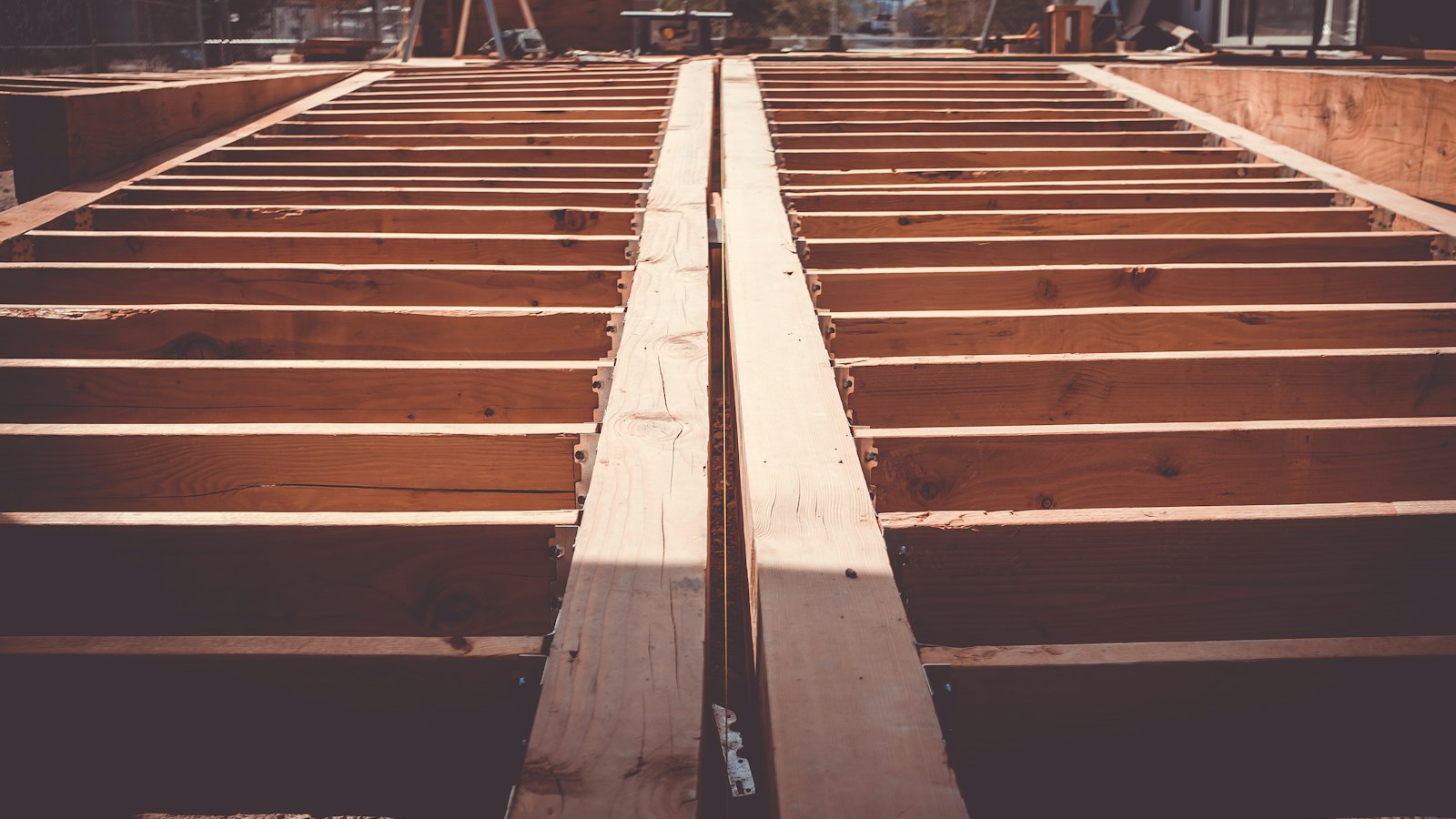
Four names turn up for the boards around the edge of a floor, and the usual answer is that they all mean the same thing. That is half right. Two of them are the same board. One is a different member in a different place with a rule of its own. And one is not a nickname at all, it is a manufactured product with a standard behind it.
| Name | What it is | Where the code says so |
|---|---|---|
| Rim joist | The board closing the joist ends | IRC R502.7 |
| Band joist | The same board | IRC R502.7 |
| Header joist | Also the member at a floor opening | IRC R502.10 |
| Rim board | An engineered product to a standard | IRC R502.1.7 |
Rim joist and band joist are the same board
There is no distinction here worth defending. The IRC puts them in the same breath: joist ends have to be restrained sideways, and section R502.7 accepts full depth solid blocking, attachment to a full depth header, band or rim joist, or attachment to an adjoining stud. Three names in one list, doing one job.
Which one you hear depends on who taught you. Band joist is more common in some regions and trades, rim joist in others, and plenty of carpenters use both in the same afternoon. If someone corrects you on it, they are expressing a preference, not a definition.
What the board actually does is the part worth knowing: it keeps the joists from rolling over, it carries the exterior wall above, and it is the leakiest detail in most houses.
Header joist is where it stops being a synonym
Header joist appears twice in the IRC and means two different things, which is the one confusion in this group that can actually cost you.
In R502.7 it is in that list of three, used loosely for the board at the joist ends. But R502.10 gives it a job of its own: openings in floor framing shall be framed with header and trimmer joists. That is the member running across a stairwell or a chimney chase, catching the joists that had to be cut, and handing their load sideways to the two full length joists either side.
It carries load that a perimeter rim joist never sees, so it has sizing rules the rim joist does not:
- Up to 4 feet of span. The header joist is a single member, the same size as the floor joists it is interrupting.
- Over 4 feet. The header joist and both trimmer joists are doubled, and sized to carry the joists framing into the header.
- A single trimmer is only allowed to carry a single header that lands within 3 feet of the trimmer’s bearing.
So if you call the board at the edge of your stair opening a rim joist, and look up what a rim joist has to be, you will find nothing about doubling at four feet. The word you used sent you to the wrong rule. This is the practical reason to keep header joist for the opening and band or rim for the perimeter, even though the code itself is loose about it in one place.
Rim board is a product, not a nickname
Drop the word joist and the meaning changes again. A rim board is a manufactured component, and the IRC treats it as one: section R502.1.7 requires engineered wood rim boards to conform to ANSI/APA PRR 410 or to be evaluated in accordance with ASTM D7672, with structural capacities established the same way, and boards conforming to PRR 410 marked accordingly.
Three sentences of code, and none of them apply to a 2x10 off the rack. That is the difference between a specified product and a piece of lumber doing the same job.
The reason it exists is depth. A floor framed in I-joists is commonly deeper than any sawn two-by can reach: the deepest standard one is a 2x12, dressed to 111⁄4 inches. Past that there is nothing to cut a rim from, so the rim comes from the same manufacturer as the joists, in a matching depth, with published capacities for the load the wall above puts through it.
Worth knowing before you order: ask for a rim joist on an I-joist floor and you may get sawn lumber that does not match the depth. Ask for rim board and you get the product the code is talking about.
And in steel, rim track
Cold-formed steel framing has its own word again. The IRC’s steel floor provisions refer to a rim track rather than a rim joist, with its own fastening schedule: a rim track or end joist connects to the load bearing wall top track with a number 8 screw every 24 inches on center.
Same position in the building, same purpose, different material and a different word. If you are reading a steel framing drawing and looking for the rim joist, this is it.
What to say at the counter
None of this matters much when you are buying lumber for a perimeter rim, because the useful information is not the name.
- Say the depth. It has to match the joists, so a 2x10 floor takes a 2x10 rim. That single number settles more than the name does.
- Say the floor system. I-joists mean rim board, and the supplier will ask for the depth and the series rather than a nominal size.
- Say which one you mean if there is an opening involved. Header joist at a stairwell is a different order from band joist round the outside, and the first one may need doubling.
Working out what the rim takes
Frequently asked
Yes. The IRC lists them together in section R502.7, which accepts attachment to a full depth header, band or rim joist as a way of restraining joist ends sideways. Which word you use is regional habit rather than a definition.
Two things, which is the trap. In R502.7 it is used loosely for the board at the joist ends. In R502.10 it is the member framing a floor opening such as a stairwell, catching the cut joists and passing their load to the trimmer joists either side. That second one carries load and has sizing rules the perimeter board does not.
Over 4 feet of span. Up to 4 feet the IRC allows a single header joist the same size as the floor joists. Beyond that, R502.10 requires the header joist and the trimmer joists to be doubled and sized to support the joists framing into the header. A single trimmer may only carry a single header landing within 3 feet of its bearing.
A rim joist is a piece of lumber doing a job. A rim board is a manufactured product with a standard behind it: IRC R502.1.7 requires engineered wood rim boards to conform to ANSI/APA PRR 410 or to be evaluated under ASTM D7672, and to be marked accordingly. The product exists mainly because engineered floors are often deeper than the deepest sawn two-by, which is a 2x12 at 111⁄4 inches.
The same depth as the floor joists, because it closes their ends and the wall above bears through it. A 2x10 floor takes a 2x10 rim. On an I-joist floor the matching depth usually does not exist in sawn lumber, which is what rim board is for.
The same component in cold-formed steel framing. The IRC’s steel floor provisions call it a rim track rather than a rim joist, and give it its own fastening schedule: a rim track or end joist is connected to the load bearing wall top track with a number 8 screw every 24 inches on center.