
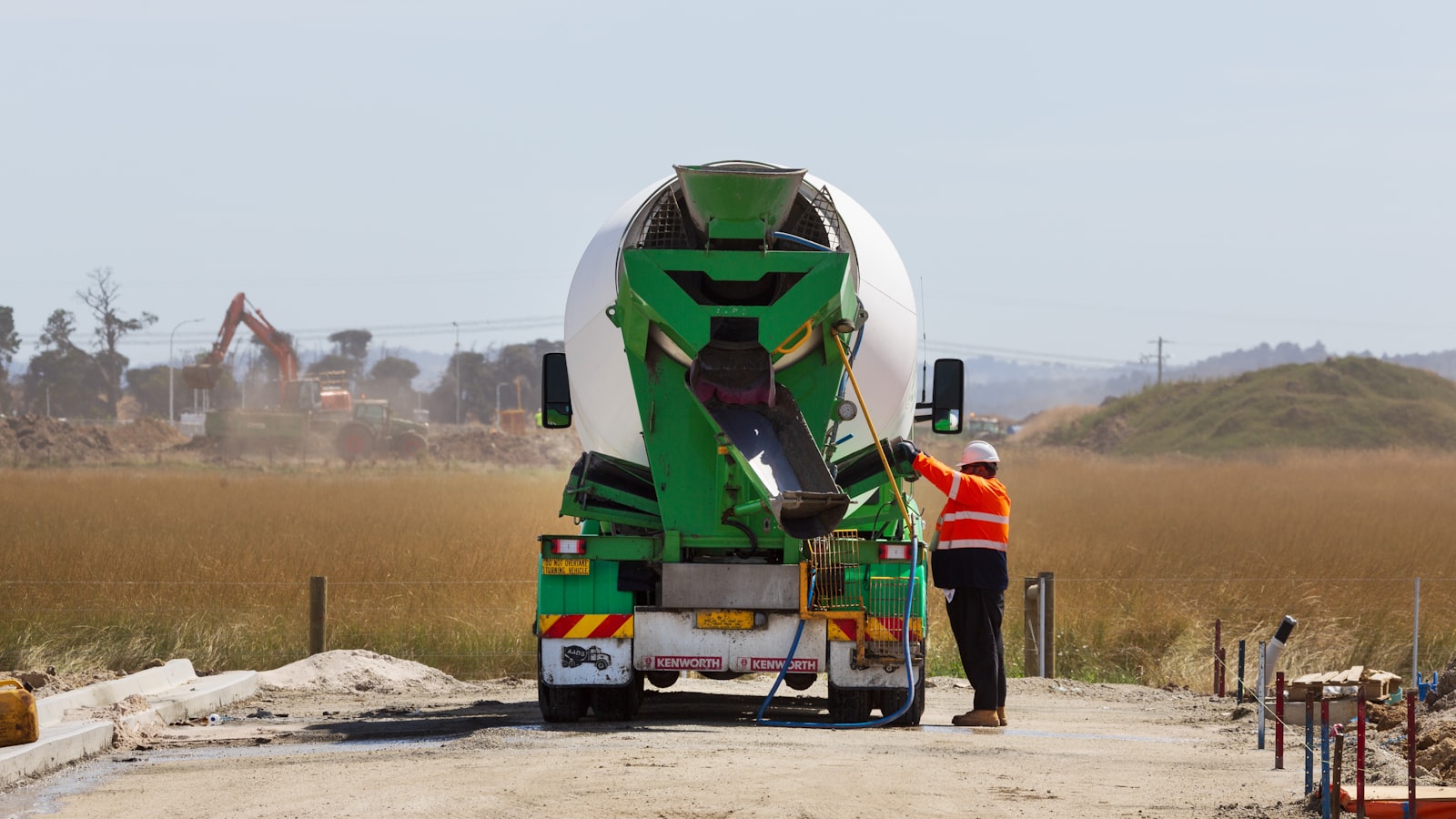
There are 45 bags of concrete in a yard, using the standard 80 lb bag. That is the answer, and for most people the more useful follow-up is that it costs nearly twice what the same yard costs delivered. Here is the full conversion table, the crossover point, and how to work out which side of it your job sits on.
How many bags of concrete in a yard, by bag size
A cubic yard is 27 cubic feet. Bags are sold by weight but used by volume, and the yield printed on the bag is what matters:
- 80 lb bag yields about 0.60 cu ft, so 45 bags to the yard.
- 60 lb bag yields about 0.45 cu ft, so 60 bags.
- 50 lb bag yields about 0.375 cu ft, so 72 bags.
- 40 lb bag yields about 0.30 cu ft, so 90 bags.
Yields vary slightly between manufacturers and between standard mix and fast-setting mix, so check the bag rather than assuming. The weight is not the useful number: 45 bags of 80 lb mix is 3,600 pounds, and that is what you will be moving.
Bags to the yard
bags = 27 ÷ yield per bag
27 cubic feet to the yard · an 80 lb bag yields about 0.6 cu ft, so 45 bags
What that means in money
At around $6.50 for an 80 lb bag, a cubic yard in bags costs roughly $292.50 in material. The same yard delivered as ready-mix runs about $160.
So you pay nearly 80% more for the privilege of mixing it yourself, and the labor is not trivial: 45 bags is one and three quarter tons to lift, open, mix and place inside the working time of the first batch.
Where the crossover sits
Bags win on small pours and lose badly on large ones. These are common jobs, each with a 10% allowance included:
- 3 by 3 ft shed pad, 4in deep: 0.12 cu yd, 6 bags, about $39. Clearly bags.
- 4 by 4 ft landing, 4in: 0.22 cu yd, 10 bags, about $65. Still bags.
- 8 by 8 ft patio, 4in: 0.87 cu yd, 40 bags, about $260. The decision point.
- 12 by 10 ft patio, 4in: 1.63 cu yd, 74 bags, about $481 against roughly $261 delivered.
- 20 by 20 ft driveway, 5in: 6.79 cu yd, 306 bags, about $1,989 against roughly $1,086 delivered.
The practical line sits around half a cubic yard, or about 25 bags. Below it, bags are cheaper once delivery and short-load fees are counted, and you can work at your own pace. Above it, ready-mix wins on cost, on consistency, and on something that does not appear on any invoice.
The reason large pours want ready-mix is not really the price. It is the cold joint. Concrete placed after the previous batch has begun to set does not bond to it, leaving a plane of weakness through the slab. Forty bags mixed in sequence is a race you can lose; one truck placed continuously is not.
Can you actually carry them?
This catches people more often than the arithmetic does. Forty-five 80 lb bags is 3,600 pounds of dry mix, which is well beyond the payload of most half-ton pickups and every passenger car.
A half-ton truck rated at 1,500 lb takes about 18 bags safely, so even a modest 8 by 8 patio at 40 bags is two or three trips or a delivery. Suppliers will palletize and deliver bags, which is often the sensible middle option: bag control on site, without moving two tons yourself.
Before you order either way
Ask about short-load fees
Ready-mix suppliers charge a surcharge below a full truck, typically under about 3 cubic yards, and it can be substantial on a small pour. Get the figure when you quote, because it may move the crossover for your specific job.
Check the yield, not just the weight
Fast-setting mixes and crack-resistant blends do not always yield the same volume per pound as standard mix, and the difference compounds across a large bag count. The yield in cubic feet is printed on the bag; use that number rather than assuming 0.6 because the bag says 80 lb. Quikrete publishes them as well: its concrete mix data sheet gives 0.60 cubic feet for the 80 lb bag, 0.45 for the 60 and 0.30 for the 40.
Order slightly over, never exactly
The truck will not wait while you find more, and a second delivery for a quarter yard costs more than the concrete in it. An uneven subgrade quietly absorbs material, which is what the waste allowance is really covering.
Have more hands than you think you need
This is the one that catches people out on bag jobs. Mixing, placing, screeding and floating all have to happen before the concrete sets, and the clock starts on the first batch rather than the last. A pour that is comfortable with three people is a disaster with one.
Measuring something that is not a rectangle
Most bag counts go wrong at the measuring stage rather than the conversion. An L-shaped patio is two rectangles: split it at the corner, work each one out separately and add the results. A circular pad is the radius squared times 3.14, so a 6 ft circle is 3 times 3 times 3.14, about 28 square feet.
Depth is the one to check twice, because it is the only measurement in inches while everything else is in feet, and because subgrade is rarely as flat as it looks. If one end of an excavation is an inch deeper than the other, use the average rather than the shallow end.
Getting your own number
Volume is length times width times depth, with the depth converted from inches to feet, then divided by 27 to reach cubic yards. Four inches is a third of a foot, so a 10 by 10 slab at 4 inches is 100 times 0.333, or 33.3 cubic feet, which is 1.23 cubic yards before any allowance.
The concrete calculator does that and gives you the bag count and the cost side by side. For setting posts rather than pouring flat, the post hole concrete calculator handles cylinders and subtracts the post itself, and the gravel calculator works out the compacted base that goes underneath a slab.
Concrete volume for a slab
cubic yards = L × W × ( D ÷ 12 ) ÷ 27
L = length in feet · W = width in feet · D = depth in inches
Work out your own pour
Frequently asked
Forty-five 80 lb bags, since each yields about 0.6 cubic feet and a cubic yard is 27. A 60 lb bag yields 0.45 cu ft, so 60 bags; a 50 lb bag 72 bags; a 40 lb bag 90 bags.
Bags are cheaper below about half a cubic yard, once delivery and short-load fees are counted. Above that ready-mix wins: a cubic yard is about $292.50 in 80 lb bags against roughly $160 delivered.
About 74 bags of 80 lb mix at 4 inches deep, including a 10% allowance, which is 1.63 cubic yards. At that size ready-mix is both cheaper and better, since the whole slab can be poured without a cold joint.
Around 4,000 pounds, or two tons, at a typical density of 145 pounds per cubic foot. In 80 lb bags you would be handling 3,600 pounds of dry mix before adding water.
A plane of weakness where fresh concrete is placed against a batch that has already started setting, so the two never bond. It is the main reason large pours want a single continuous delivery rather than sequential bags.