
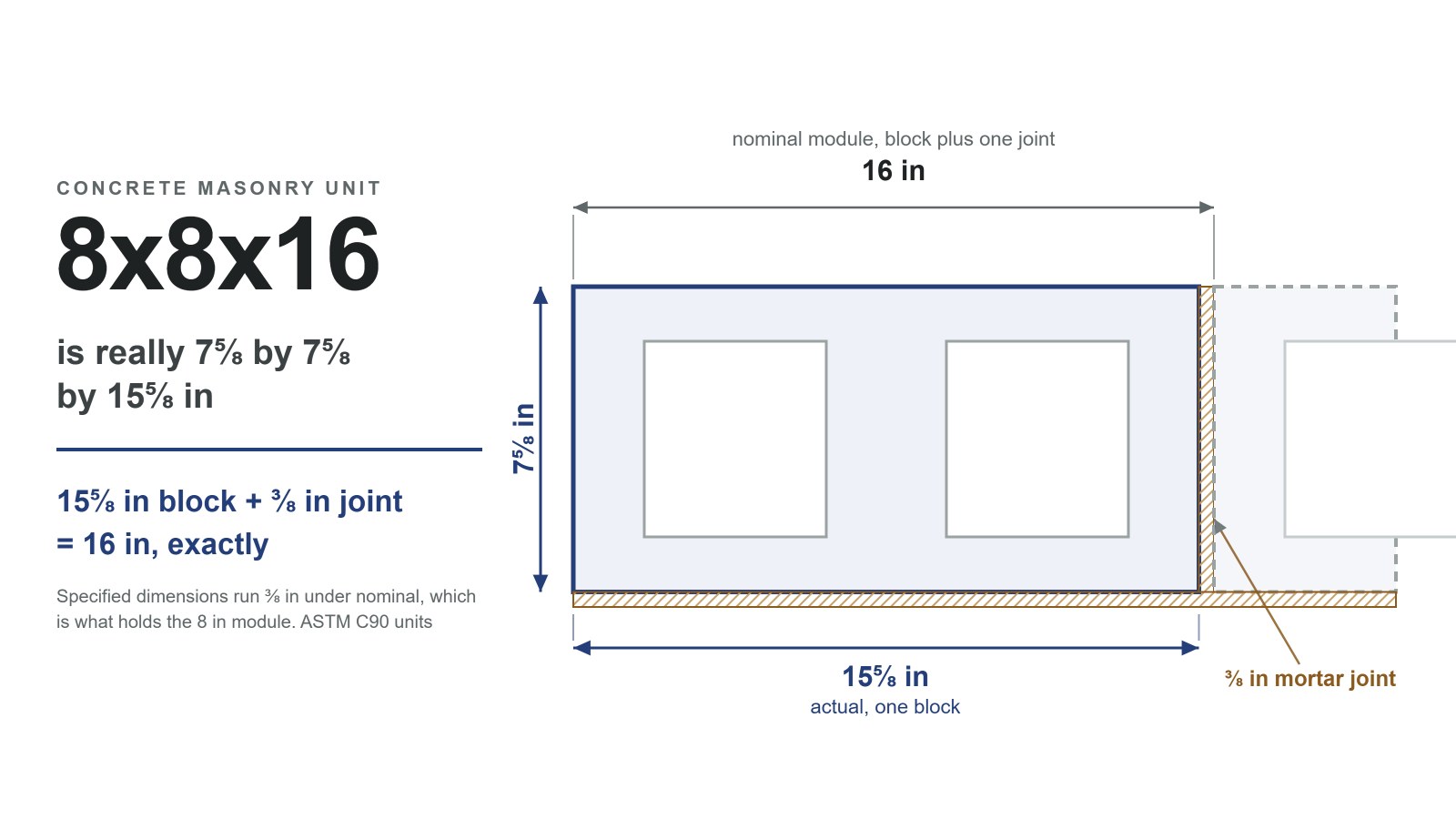
A standard concrete block measures 75⁄8 inches wide, 75⁄8 inches high and 155⁄8 inches long. Every face is 3⁄8 of an inch short of the round number the block is sold under, and that 3⁄8 is not shrinkage, a tolerance or a manufacturing miss. It is the mortar joint, reserved in advance.
This is where block parts company with lumber. A 2x4 is never 2 by 4 inches no matter what you add to it. A concrete block becomes exactly 8 by 16 the moment it is laid, because one unit plus one joint is the nominal size. So on a block job the nominal figure is the one you lay out with, and the smaller figure is only for checking a single block on the pallet.
Nominal and actual block sizes
Blocks are named width first, then height, then length. The Concrete Masonry and Hardscapes Association states that specified dimensions are typically 3⁄8 in. less than nominal, which is what produces this table. Height and length never change; only the width does.
| Nominal, W x H x L | Actual, W x H x L |
|---|---|
| 4 x 8 x 16 in | 35⁄8 x 75⁄8 x 155⁄8 in |
| 6 x 8 x 16 in | 55⁄8 x 75⁄8 x 155⁄8 in |
| 8 x 8 x 16 in | 75⁄8 x 75⁄8 x 155⁄8 in |
| 10 x 8 x 16 in | 95⁄8 x 75⁄8 x 155⁄8 in |
| 12 x 8 x 16 in | 115⁄8 x 75⁄8 x 155⁄8 in |
Half blocks
A half block is half the length and nothing else. It exists so that a corner or the end of a wall can be closed without cutting, and it follows the same rule: 8 inches nominal, 75⁄8 actual.
| Nominal, W x H x L | Actual, W x H x L |
|---|---|
| 4 x 8 x 8 in | 35⁄8 x 75⁄8 x 75⁄8 in |
| 6 x 8 x 8 in | 55⁄8 x 75⁄8 x 75⁄8 in |
| 8 x 8 x 8 in | 75⁄8 x 75⁄8 x 75⁄8 in |
| 10 x 8 x 8 in | 95⁄8 x 75⁄8 x 75⁄8 in |
| 12 x 8 x 8 in | 115⁄8 x 75⁄8 x 75⁄8 in |
The rule worth memorizing
Actual = nominal − 3⁄8 in, on every face
One rule, three dimensions, every width. Lumber needs two rules and a moisture column; block needs this.
Why it is 3⁄8 of an inch
Because 3⁄8 is the mortar joint, and subtracting it from every face is what keeps the wall on a module. A 155⁄8 inch block plus a 3⁄8 inch joint is 16 inches dead. A 75⁄8 inch course plus its bed joint is 8 inches dead. CMHA puts it plainly: the 3⁄8 in. difference is what maintains a 4 or 8 in. module with 3⁄8 in. mortar joints.
That is the whole reason the number is odd. Once you accept the joint as part of the block, every figure on a block job is a multiple of 8 inches, and the arithmetic stops fighting you. Twenty blocks in a run is 320 inches, exactly. Nine courses is 72 inches, exactly.
Nominal, specified, actual
Three words get used loosely and they mean three different things.
- Nominal is the planning module. It is 8 x 8 x 16, and it is the number to lay out, estimate and draw with.
- Specified is what the block is made to. It is 75⁄8 x 75⁄8 x 155⁄8, and it is the figure engineering calculations are based on.
- Actual is what came out of the machine that day, which is allowed to differ from the specified size by no more than 1⁄8 of an inch either way.
In everyday use “actual” and “specified” are treated as the same thing, and for ordering purposes they are. The distinction matters when a wall has to meet a fixed opening and the eighth of an inch per block has somewhere to accumulate.
Loadbearing units are covered by ASTM C90, which is the standard a block is sold against and the one a drawing will name. It governs more than the outside: when the standard was revised, the minimum web thickness became 0.75 in for every unit size, with a normalized web area of at least 6.5 square inches per square foot.
Where the missing 3⁄8 inch actually bites
Most of the time the joint takes care of itself. These are the moments it does not.
- Measuring a single block to size a wall. Lay a tape on one block, get 155⁄8, multiply by twenty and you are 71⁄2 inches short of the wall you will actually build. Count in nominal, always.
- Runs that are not a multiple of 8. The joint is part of the module, so stretching or pinching joints to absorb a few spare inches moves everything stacked above it. A cut block or a half block absorbs it in one place instead.
- Openings and bucks. A rough opening laid out in whole blocks lands on the module. One laid out from actual block sizes drifts by 3⁄8 of an inch for every block, which is three inches across an eight block opening.
- Finished wall thickness. A nominal 8 inch block wall is 75⁄8 inches of masonry, not 8, because the end of the wall has no joint beyond it. Sills, caps and wall plates are sized to that figure.
How many blocks cover 100 square feet
This one is arithmetic rather than a specification. A nominal block face is 8 by 16 inches, which is 128 square inches, or 0.889 square feet. Divide 100 by that and you get 112.5 blocks per 100 square feet of wall, before openings are taken out and before any allowance for breakage and cuts.
Use the nominal face for this, not the actual one. The actual face of 75⁄8 by 155⁄8 is 0.827 square feet, and counting with it would have you buy roughly 121 blocks for the same wall, which is eight percent of a pallet you do not need.
Cinder block, concrete block, CMU
Three names, one product, same dimensions. The industry term is concrete masonry unit, shortened to CMU on drawings and in specifications. Yards and suppliers say concrete block. Everybody else says cinder block. None of that changes the sizes above, and a loadbearing unit of any of those names is sold against ASTM C90.
Size the footing under the wall
Frequently asked
A standard 8 inch concrete block measures 75⁄8 inches wide, 75⁄8 inches high and 155⁄8 inches long. Every face is 3⁄8 of an inch under the nominal 8 by 8 by 16 it is sold as, and that 3⁄8 is the mortar joint.
So that the block plus its mortar joint comes to exactly 16 inches. The same applies to the height: a 75⁄8 inch course plus a 3⁄8 inch bed joint is 8 inches. Subtracting the joint from the unit is what keeps a block wall on an 8 inch module.
Half the length and nothing else. A half block is 8 inches nominal and 75⁄8 inches actual in length, while its width and height match the full block it pairs with. An 8 inch half block is 75⁄8 by 75⁄8 by 75⁄8 inches.
112.5 blocks, using the nominal 8 by 16 inch face of 0.889 square feet. That figure is before openings are deducted and before any allowance for breakage and cuts, so round up rather than down.
Yes. Cinder block, concrete block and concrete masonry unit are three names for the same product, and the nominal and actual sizes are identical whichever name the yard uses. A loadbearing unit is sold against ASTM C90 under any of them.
Nominal 4, 6, 8, 10 and 12 inches, which measure 35⁄8, 55⁄8, 75⁄8, 95⁄8 and 115⁄8 inches. Height and length stay the same across all five at 75⁄8 by 155⁄8 inches, so only the width changes.